Affiliate disclosure: links to Jenson USA and Competitive Cyclist on this page are affiliate links. We may earn a commission at no extra cost to you.
The short version
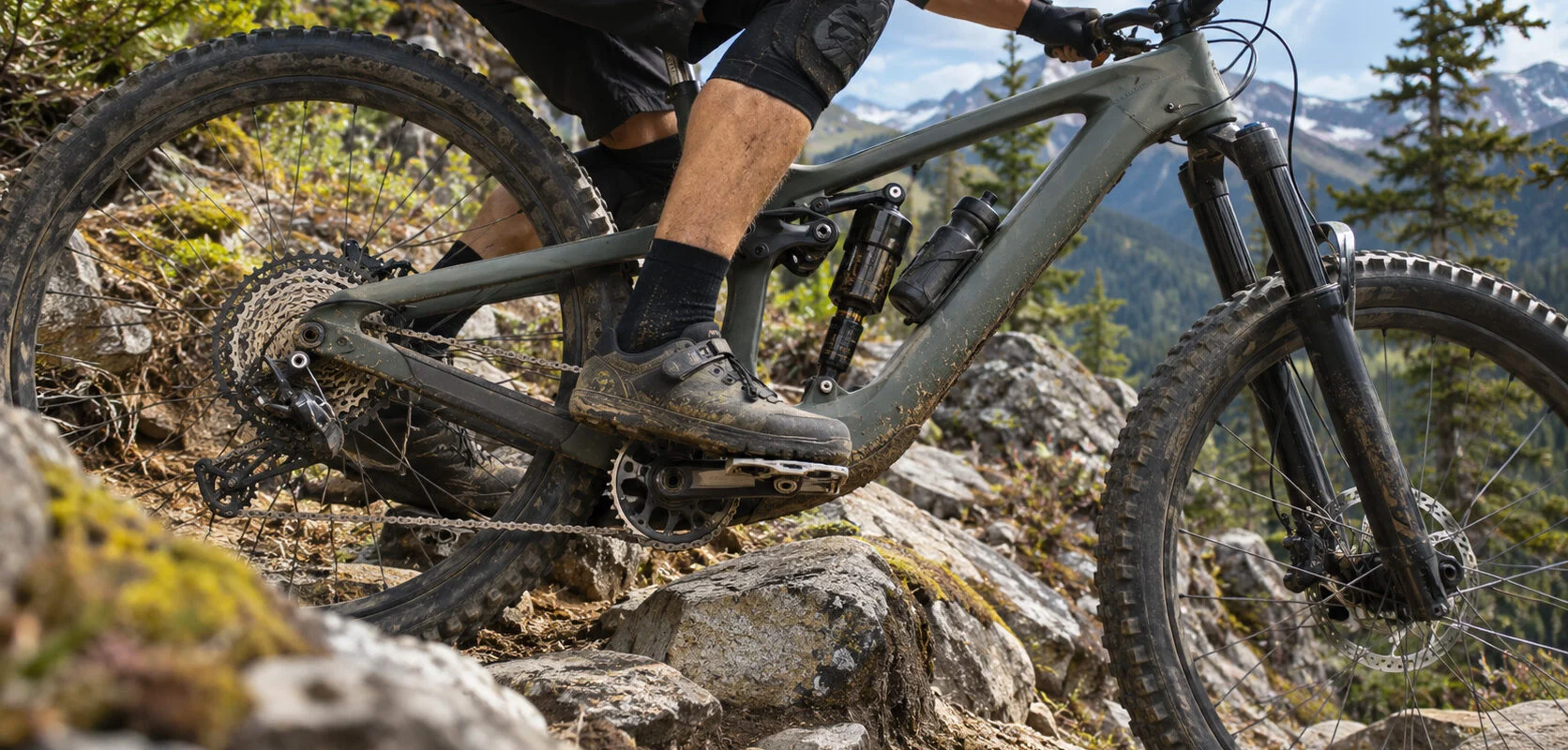
Every millimeter you take off your crank arms is a millimeter of pedal clearance you get back at the bottom of the stroke. Go from 170mm to 160mm and your pedal sits 10mm further from the rock you keep clipping. The studies on crank length say you give up almost nothing in power to get it, as long as you stay away from the extremes.[1]
You do give up leverage. A shorter arm is a shorter lever, so the same gear feels harder, and most riders who go short end up fitting a smaller chainring. You also need to raise your saddle, and that can run you out of dropper post. So a crank swap is rarely just a crank swap. Budget for a chainring and check your seatpost before you order anything.
If you ride a low bottom bracket trail or enduro bike, an eMTB, or a 29er you converted to a mullet, short cranks are one of the cheaper fixes for pedal strikes. If you are tall, ride a high bottom bracket XC bike, and never hit your pedals, you can leave this one alone.
Why 175mm was never a careful choice
For years a mountain bike shipped with 175mm cranks, or 170mm on the small sizes, regardless of whether the rider was 5’4″ or 6’4″. Nobody chose that number for you. It carried over from road bikes and stayed because every crank in the catalog came that way.
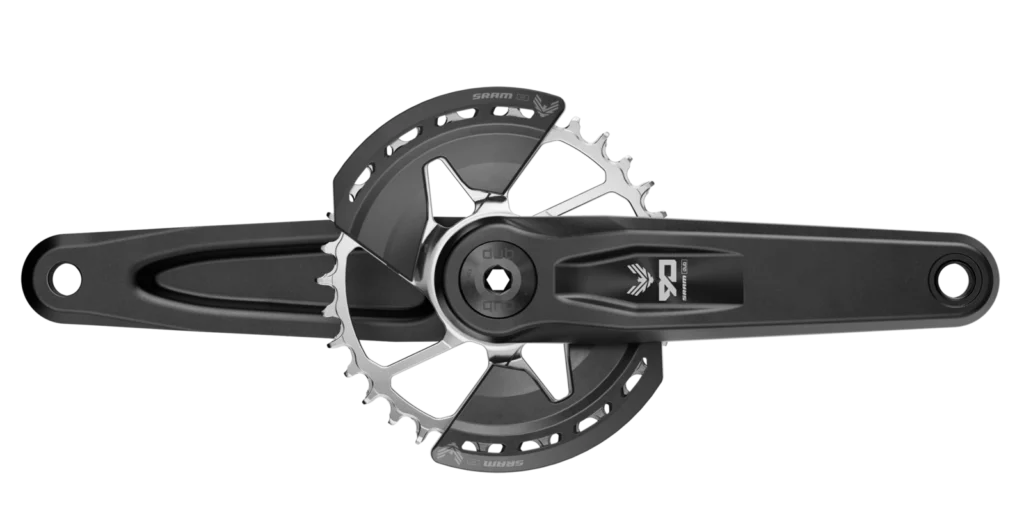
That has changed quickly. SRAM now sells its Eagle 90 Transmission crankset in 155mm and 160mm alongside the usual sizes.[5] Race Face’s carbon Era crank starts at 160mm.[4] Hope’s Evo goes down to 155mm, and YT has shipped the Decoy SN with 160mm arms out of the box.[7][10] The parts exist now, which was the main thing holding riders back.
What the research says about power
The worry is always the same: shorter lever, less power. The lab work doesn’t back that up.
The study everyone cites is Martin and Spirduso from 2001. Sixteen trained cyclists did all-out sprints on cranks from 120mm to 220mm, a range far wider than anything you can buy for a trail bike. The gap between the best and worst length was 3.9 percent, and the losers were the two extremes.[1] Riders simply spun the short cranks faster.
A few other findings matter for mountain bikers:
- Macdermid and Edwards tested seven female cross country racers on 170, 172.5, and 175mm cranks. Power was the same, but the riders reached peak sprint power sooner on the 170s.[1]
- McDaniel’s group found that the energy cost of pedaling tracks pedal speed, meaning crank length multiplied by cadence, and not crank length on its own.[1]
- Ferrer-Roca’s 2016 study measured more hip and knee range of motion on longer cranks, with no gain in efficiency.[1]
- Park’s 2021 study looked at standing pedaling and found longer cranks soaked up more power on the upstroke.[1]
These are small studies, mostly on stationary bikes, and none of them had anyone climbing a wet root ladder. I’d read them as “power is not the reason to avoid short cranks” and not as proof that shorter is faster.
 From the Bike198 shopN+1 = The Amount of Bikes You Need$24.99Shop
What changes on the bike
Pedal clearance
The clearance math is simple. At the bottom of the stroke, the pedal hangs one crank length below the bottom bracket. Shorten the crank by 10mm and the pedal is 10mm higher.
That matters more than it sounds. In our mullet conversion guide, the bottom bracket drops 10 to 12.5mm when a 27.5 rear wheel goes into a 29er frame. Swap 175mm cranks for 160mm on that bike and you have recovered the whole drop with about 3mm to spare.
Leverage and gearing
Torque at the crank is pedal force multiplied by arm length, so leverage falls in step with length. To keep the same effort at the pedal, shrink the chainring by the same percentage.
| Swap | Clearance gained | Leverage lost | Chainring to match a 32T |
|---|---|---|---|
| 175mm to 165mm | 10mm | 5.7% | 30T |
| 170mm to 165mm | 5mm | 2.9% | 32T (no change) |
| 170mm to 160mm | 10mm | 5.9% | 30T |
| 170mm to 155mm | 15mm | 8.8% | 28T or 30T |
| 175mm to 155mm | 20mm | 11.4% | 28T |
Germany’s BIKE magazine ran Hope Evo cranks at 155mm against 170mm and went from a 32T ring to a 28T to get the climbing feel back.[2] That is a bigger step than the math asks for, which tells you how much steep, slow, technical climbing punishes a short lever. The cost of a smaller ring is top end. You will spin out sooner on fire road descents.
Cadence
Your foot travels a smaller circle. A 170mm crank traces about 1,068mm per revolution and a 155mm crank about 974mm. To keep your foot moving at the same speed you pedal faster: 80 rpm on 170s becomes roughly 85 rpm on 160s and 88 rpm on 155s. Most riders adapt within a few rides.[1]
Saddle height and your dropper
Raise the saddle by the amount you shortened the crank, so your leg extension at the bottom of the stroke stays the same.[1] Go 10mm shorter and the saddle goes up 10mm.
This is where the hidden cost shows up. If your dropper is already sitting at its minimum insertion line, you don’t have 10 or 15mm to give, and you need a longer post. If your post is slammed to the collar with room to spare, you are fine. Our dropper post buyer’s guide covers travel and insertion lengths if you end up shopping.
Stance on the descents
With the pedals level, your feet sit closer together front to back. On 155mm arms that is 30mm less than on 170s. BIKE’s tester found it easier to keep his heels low in that more compact stance and felt more stable when the bike got knocked around.[2] Vital MTB’s tester tried 145, 155, and 165mm and landed on 155mm. He reported that 165mm felt too close to 170mm to bother with, and that 145mm was past the point of diminishing returns.[3]
What you give up
Standing starts on steep, technical climbs get harder. Both the BIKE test and the forum threads agree on that, and a smaller chainring only partly fixes it.[2] If your local riding is slow, ledgy climbing where you muscle the bike up one half pedal stroke at a time, go down one size and stop there.
A smaller ring also lowers your top gear. And on a 5mm change you may feel nothing at all, which makes it an expensive experiment. If you are on 170mm and want to notice a difference, 160mm is the smallest step I’d spend money on.
Sizing: how short should you go?
Pinkbike’s Seb Stott worked back from the leg length figures in the research and came up with a rough rule of 9.2 percent of rider height. He called the numbers very rough, and I’d treat them the same way.[1] Bike fitters who work from inseam tend to use 20 to 20.5 percent of inseam length, which lands in about the same place.
| Rider height | 9.2% of height | Closest production length |
|---|---|---|
| 5’2″ (157cm) | 145mm | 150 or 155mm |
| 5’5″ (165cm) | 152mm | 155mm |
| 5’8″ (173cm) | 159mm | 160mm |
| 5’10” (178cm) | 164mm | 165mm, or 160mm if clearance is the goal |
| 6’0″ (183cm) | 168mm | 165 or 170mm |
| 6’2″ (188cm) | 173mm | 170 or 175mm |
| 6’4″ (193cm) | 178mm | 175mm |
Read that table as a floor on what is reasonable, not a prescription. A 6’2″ rider who smacks pedals all day on a low enduro bike has a good reason to run 165mm. A 5’8″ rider on 175mm cranks is the person with the most to gain.
Which cranks come in short lengths
| Crankset | Lengths | Material and spindle | Price seen | Where to buy |
|---|---|---|---|---|
| SRAM Eagle 90 Transmission | 155, 160, 165, 170, 175mm | Forged aluminum, DUB Wide, includes 32T steel ring | $170 MSRP, from $136 on sale[5] | Jenson USACompetitive Cyclist |
| Shimano Deore XT FC-M8200 | 160mm and up | Hollow forged aluminum, 24mm spindle, chainring sold separately | $190[8] | Jenson USACompetitive Cyclist |
| Canfield AM/DH | 155, 160, 165, 170mm | 7075 aluminum, 24mm spindle, DH spindle option | $229.99 AM, $244.99 DH[9] | Canfield direct |
| Race Face Era | 160, 165, 170, 175mm | Carbon, 30mm spindle | Check current price[4] | Competitive Cyclist |
| Hope Evo | 155 to 175mm | Forged and machined aluminum, 30mm spindle | $395[7] | Jenson USA |
| 5DEV R-Spec Trail/Enduro | 135 to 175mm | Machined aluminum, SRAM 3-bolt ring mount | $549.99[7] | Jenson USACompetitive Cyclist |
Prices move, so confirm before you buy. SRAM’s entry level SX Eagle crank has also been listed in 155mm if you are on an older Eagle drivetrain and want the cheapest way in.[10]
Compatibility checks before you order
- Match the spindle to your bottom bracket. DUB, Shimano 24mm, and 30mm spindles each need their own bottom bracket. Staying within the same family saves you buying one.
- Match the chainring mount. SRAM’s Transmission cranks use an 8-bolt T-Type ring made for flattop chains. Older SRAM cranks use the 3-bolt direct mount, and Shimano has its own direct mount. Our SRAM GX T-Type review has more on the Transmission parts.
- Check chainline. Most current trail frames want 55mm. Older Boost frames may want 52mm.
- Re-check chain length after you change ring size. A 2T drop is usually fine. A 4T drop may want a link out. Our derailleur install and adjustment guide walks through it.
What the swap costs
The crank price is only part of it. Here is a realistic range for a rider going from 170mm to 160mm. The crankset figures come from the listings above. The other lines are typical street prices and will vary by brand.
| Item | When you need it | Typical cost |
|---|---|---|
| Crankset | Always | $155 to $550 |
| Smaller chainring | Most riders dropping 10mm or more | $25 to $90 |
| Bottom bracket | Only if you change spindle standard | $40 to $60 |
| Longer dropper post | Only if your post is at minimum insertion | $150 to $350 |
| Shop labor | If you don’t own the tools | $30 to $60 |
Best case, you stay in the same crank family and spend about $180 to $200 on arms and a ring. Worst case, with a boutique crank, a new bottom bracket, and a dropper, you are past $900. Know which rider you are before you start.
Short cranks on an eMTB
This is the easiest case to make. An eMTB is heavy, it sits low, and you pedal it through terrain you would coast on a regular bike, so pedal strikes are constant. The motor covers the leverage you lose. BIKE’s tester gave a flat recommendation for short cranks on eMTBs and gravity bikes for that reason.[2]
eMTB crank arms are specific to the motor interface, so you can’t use the cranks in the table above. SRAM’s Eagle 90 e-MTB arms (Bosch version at Jenson USA) come in 150 through 170mm for Bosch, Brose, and SRAM’s own drive units, at around $100 to $110.[6] Shimano motors use a different spline. Our eMTB motor comparison lays out which system is on which bike.
FAQ
Will I lose power with shorter cranks?
Not in any way the research can measure, inside the range sold for mountain bikes. You lose leverage, which you feel as a harder gear, and you fix that with a smaller chainring.[1]
Is 165mm short enough?
From 175mm, yes, that is a real change. From 170mm it is 5mm, and at least one tester who tried several lengths could barely tell them apart.[3] If you are already on 170mm, look at 160mm.
Do I have to change my chainring?
No. Plenty of riders leave it alone on a 5mm or 10mm change and just live with a slightly harder low gear. If you are already using your easiest gear on every climb, drop 2T.
Do short cranks help with knee or hip pain?
One study measured less hip and knee range of motion on shorter cranks.[1] That is not the same as showing they fix pain. If you have a joint problem, see a bike fitter or a physical therapist before spending money on parts.
Can I go too short?
Yes. Vital’s tester found 145mm gave back most of what 155mm gained.[3] For most adults, 155mm is the practical floor on a pedal bike.
Bottom line
Short cranks fix one problem well, and that problem is pedal clearance. If you hit pedals often, 160mm is the sensible first step from 170mm, with a 30T ring if you were on a 32T. Go to 155mm if you are under about 5’7″, ride an eMTB, or have a mulleted 29er with a bottom bracket that is too low. Measure your dropper insertion first. And if you never strike a pedal, keep your money for tires.
Sources
- Seb Stott, “Why Shorter Cranks Are Better (According To Science),” Pinkbike, November 2021
- Max Fuchs, “155 mm vs. 170 mm: Short cranks in the test,” BIKE Magazin, May 2026
- “Shorter Cranks – Are They for You?” Vital MTB
- Race Face Era crankset long-term review at 160mm, Singletracks
- SRAM Eagle 90 Transmission Crankset product page
- SRAM Eagle 90 Transmission E-MTB Crank Assembly product page
- Zinn Cycles short MTB crank listings (Hope Evo, 5DEV R-Spec)
- Worldwide Cyclery crankset listings (Shimano Deore XT FC-M8200, 160mm)
- Canfield AM/DH Crank, Vital MTB product guide
- Dan Joyce, “Review: Hope Technology Evo Crankset 155mm,” Cycling UK; “Are shorter MTB cranks really better?” road.cc

I founded Bike198 back in 2008 and started riding bikes seriously in 1994. A lot has changed since that time and one of the greatest releases is still getting out on the bike and shredding trail or tearing up the road.