
Review Last Updated: January 31, 2026
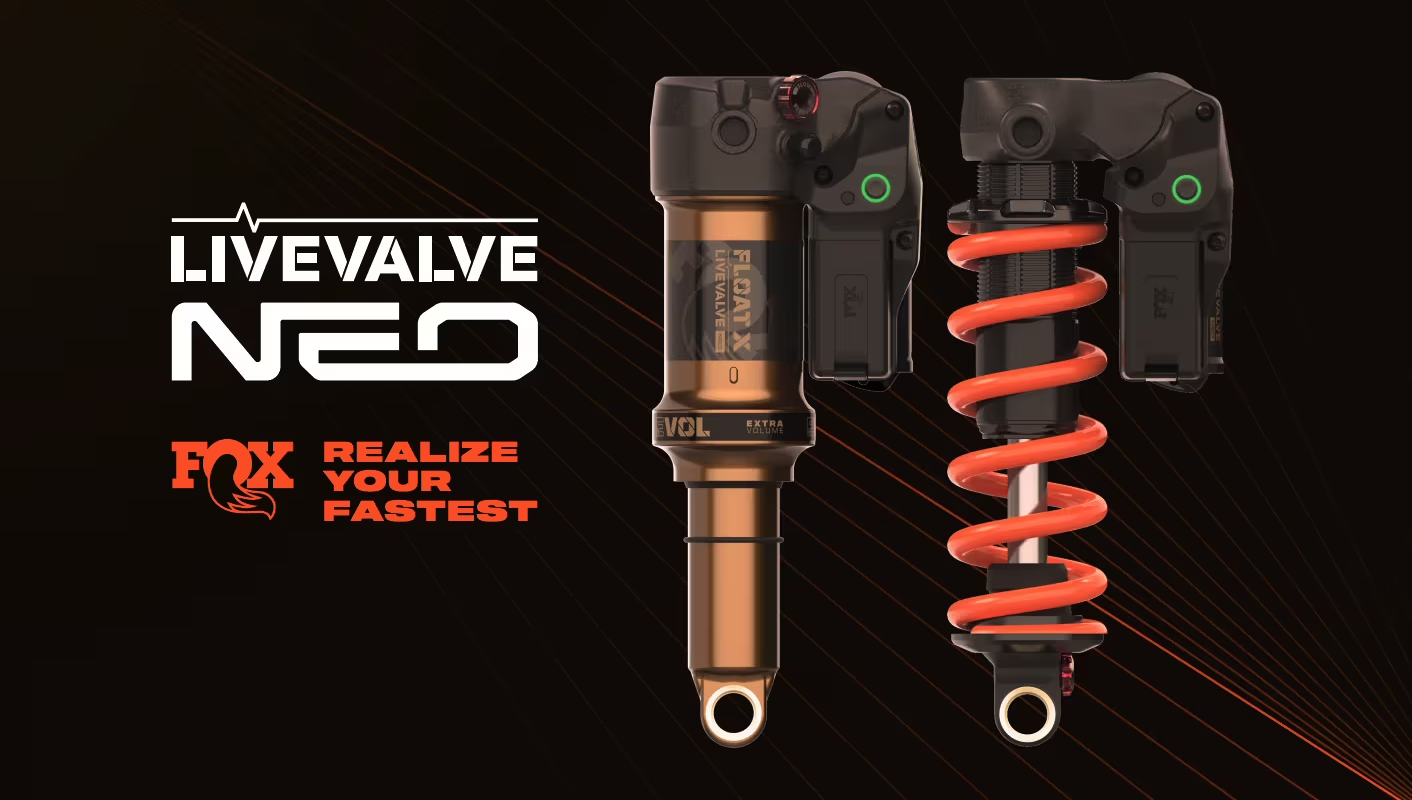
Products in Review – Live Valve NEO Kit / Live Valve Neo Coil Shock / Live Valve Neo Air Shock
Part I: The Historical Context of Active Suspension
The Eternal Conflict of Dynamics
To understand the significance of the Fox Racing Shox Live Valve Neo, one must first understand the fundamental conflict that has plagued mountain bike suspension design since the first elastomer bumpers were shoved into front forks in the early 1990s. This conflict is the war between efficiency and compliance.
In a perfect world, a mountain bike suspension system would be a chameleon. When the rider pushes on the pedals, the bike would be a rigid structure, ensuring that 100% of the muscular energy generated by the legs is transferred into the drivetrain and subsequently the rear wheel, propelling the machine forward. This requires high low-speed compression damping to resist the low-frequency, high-amplitude inputs of a rider’s mass shifting during a pedal stroke. Conversely, when the tires encounter a root, a rock, or a washboard section of trail, the suspension should instantly become supple, absorbing the impact energy to preserve momentum and rider comfort. This requires the compression damping circuit to open completely, allowing the oil to flow freely and the shaft to compress.
The problem, historically, is that mechanical systems are reactive, not proactive, and they struggle to differentiate between the rider and the terrain. A shock tuned for maximum efficiency feels harsh and skittish on descents. A shock tuned for plush, trophy-truck-like descending wallows under power, bobbing rhythmically with every pedal stroke—a phenomenon known as “pedal bob.”
Over the last three decades, engineers have employed a vast arsenal of mechanical band-aids to solve this. We have seen the introduction of platform damping (like the Fox ProPedal), inertia valves (the Specialized Brain), and complex linkage designs (VPP, DW-Link, Horst Link) designed to use chain tension (anti-squat) to stiffen the suspension under power. While these mechanical solutions have reached a high level of refinement, they all share a common flaw: they are compromises. High anti-squat can lead to pedal kickback. Strong platform damping can reduce small-bump sensitivity.
The Electronic Frontier
The automotive industry solved this problem decades ago with active suspension. By using sensors to read the road and computers to adjust damping in real-time, cars could decouple ride quality from chassis control. In the cycling world, attempts have been made—K2’s Smart Shock, Cannondale’s Simon, Lapierre’s Ei Shock—but they were often plagued by slow processing speeds, heavy batteries, and a labyrinth of wires that made installation a nightmare.
Fox Racing Shox entered the arena with the original Live Valve in 2018. It was a wired system that worked incredibly well but was hampered by its form factor. It required a frame designed to accept it, with mounting points for a central battery and internal routing for wires connecting the fork, shock, and sensors. It was a factory-only option for the most part, inaccessible to the rider who wanted to upgrade their existing bike.
Now, we have Live Valve Neo. It is the maturation of the concept. It is wireless. It is faster. And crucially, it is an aftermarket product that can be bolted onto almost any modern trail or enduro bike. It promises to finally resolve the efficiency vs. compliance conflict not with a compromise, but with a micro-processor.
Part II: The Architecture of Live Valve Neo
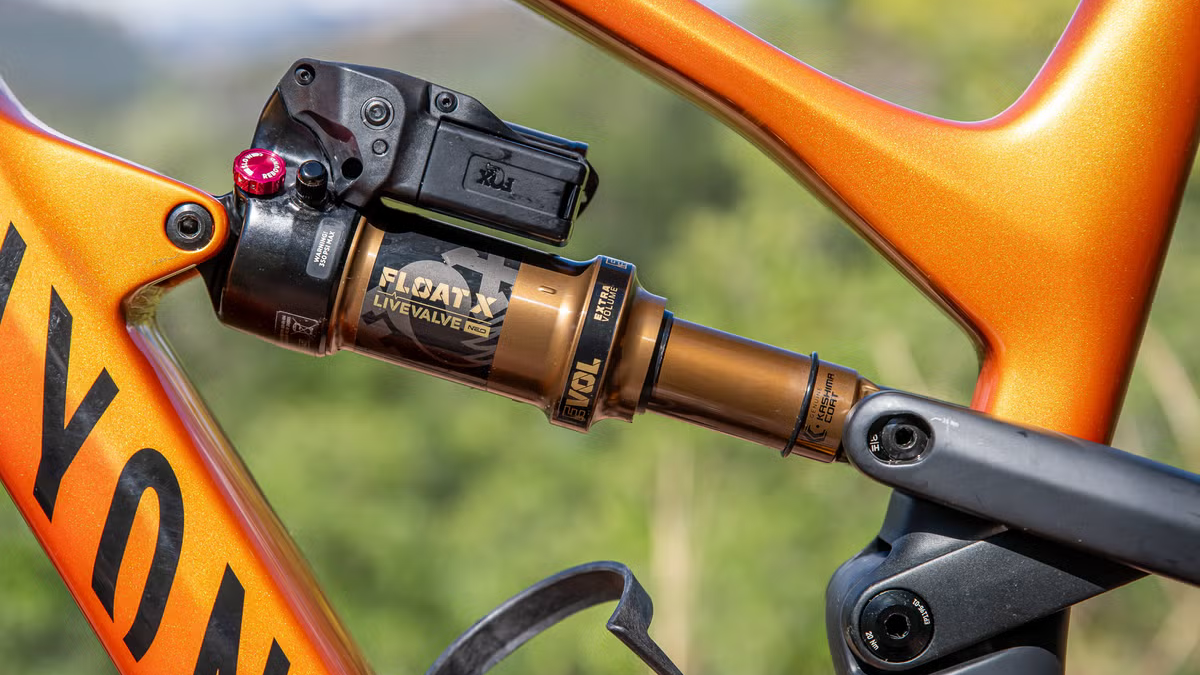
The Live Valve Neo system is not a single component but a distributed network of hardware acting in concert. To understand how it functions, we must dissect the ecosystem, which comprises the Live Valve Neo Kit and the Live Valve Neo Shock (either Float X or DHX).
1. The Wireless Protocol: Why “Neo”?
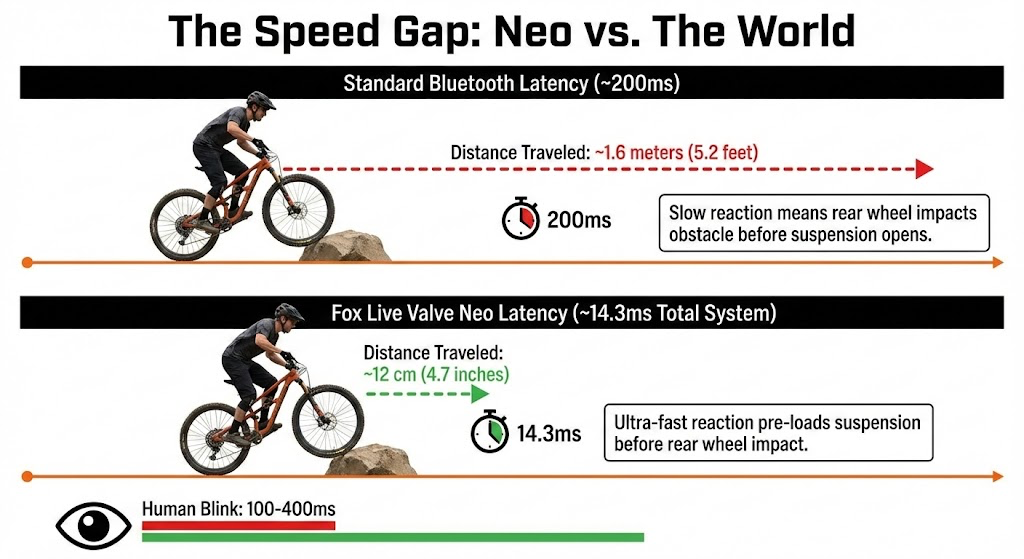
The skepticism surrounding wireless suspension has always centered on latency. In the high-stakes environment of mountain biking, where a rider might hit a square-edged rock at 30 kilometers per hour, milliseconds matter. Standard Bluetooth protocols, widely used in consumer electronics, typically suffer from latency in the range of 200 milliseconds.1
To put that in perspective, at 30 km/h (approx. 8.3 meters per second), a bike travels roughly 1.6 meters in 200 milliseconds. If the system relied on Bluetooth, the front wheel would have struck the obstacle, the rider would have felt the impact, and the rear wheel would have likely already impacted the obstacle before the signal to open the suspension even arrived at the shock.
Fox developed the Neo protocol specifically to circumvent this limitation. Neo strips away the non-essential handshake protocols and overhead of standard Bluetooth to achieve a transmission speed of approximately 1 millisecond.2 When combined with the processing time of the controller and the physical actuation time of the solenoid, the total system reaction time is 1/70th of a second (roughly 14.3 milliseconds).3
This speed is the cornerstone of the system’s viability. It allows the shock to receive a signal from the front wheel sensor and open the damping circuit before the rear wheel impacts the same obstacle, effectively “pre-loading” the suspension for the hit. It is roughly 100 times faster than Bluetooth and 20 times faster than the next fastest competitor protocol.5
2. The Shock Options: Air vs. Coil
The brain of the system resides in the Controller, which is permanently integrated into the reservoir of the shock. Fox offers two chassis options, catering to the two primary disciplines of aggressive trail riding.
The Float X Live Valve Neo
Based on the MY22+ Float X architecture, this air shock targets the trail and all-mountain category.
- Chassis: It features a high-flow main piston and the EVOL air spring, which uses a larger negative air chamber to improve initial sensitivity.
- Weight: Approximately 669g (185x55mm size, including battery).1 This is heavier than a standard Float X but eliminates the weight of a remote lockout cable and lever.
- Damping Adjustments:
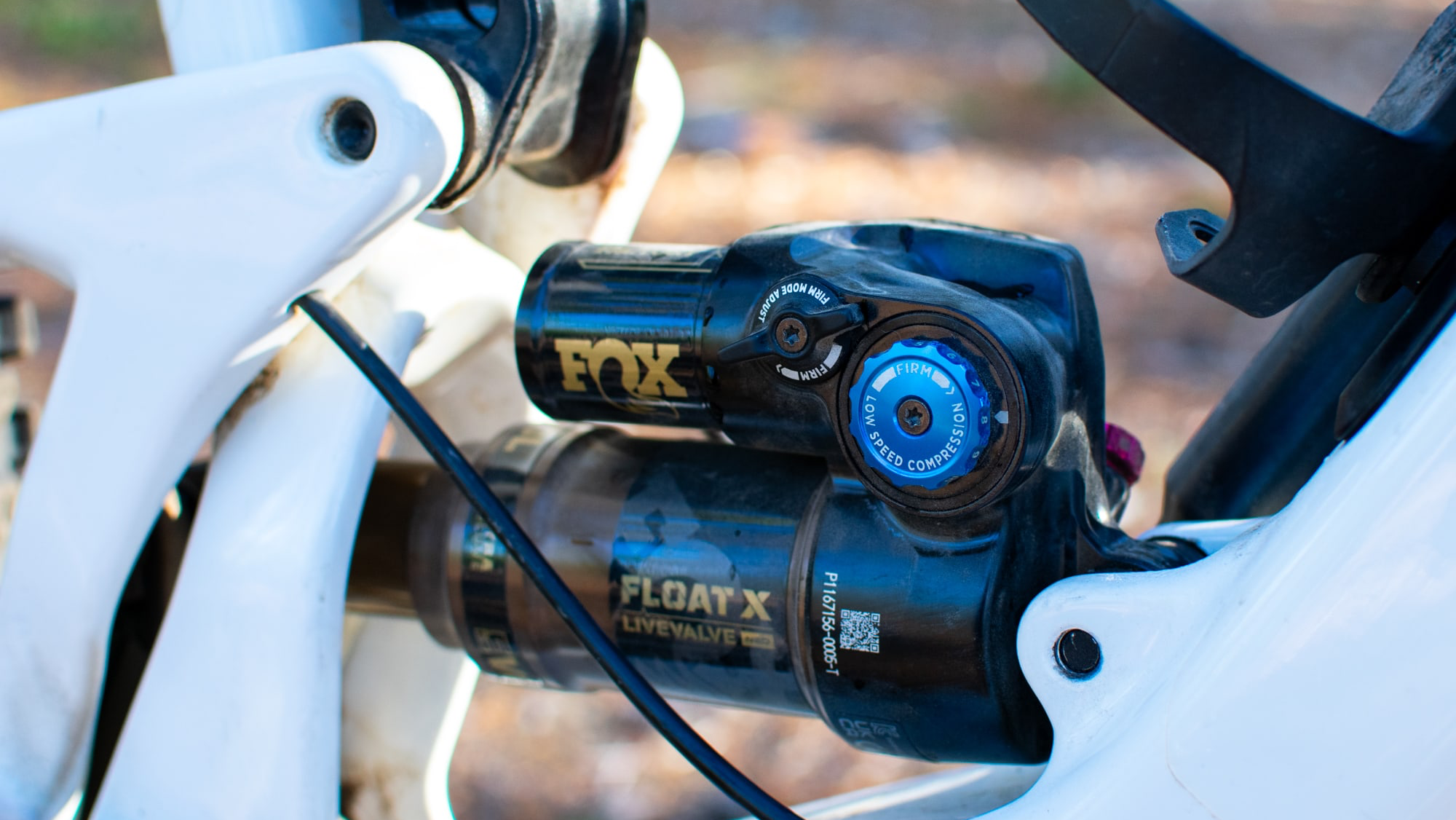
- Low-Speed Compression (LSC): 11 tool-free clicks.1 This adjusts the compression damping when the system is in the Open state.
- Firm Mode Adjust: 6 tool-free clicks.1 This is a critical differentiator. Unlike a binary lockout, the user can tune how firm the “closed” mode is. It can be a rock-solid platform for fire roads or a firmer-than-open tracking mode for technical climbing.
- Rebound: 11-13 clicks (depending on size).1
- Air Spring Tuning: Compatible with standard Float X volume spacers.5
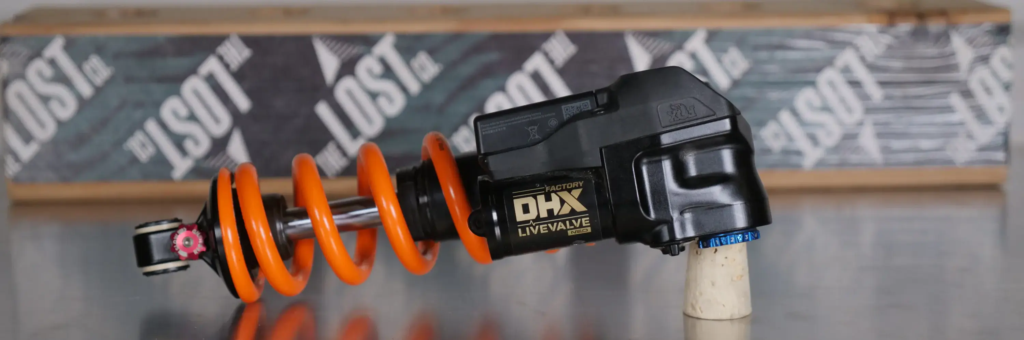
The DHX Live Valve Neo
This brings electronic efficiency to the coil-shock market. Coil shocks are prized for their lack of friction (stiction) and consistency on long descents, but they are notoriously inefficient climbers due to their linear spring rate.
- Chassis: Steel shaft, full diameter spring retainer, and MCU bottom-out bumper.7
- Weight: Approximately 701g (185x55mm, without spring).1 Once a steel spring is added, this unit will exceed 1kg, making it a choice for riders who prioritize descent performance over gram counting.
- Damping Adjustments: Identical to the Float X (11 LSC, 6 Firm Mode, Rebound).7
- The Coil Advantage: By adding Live Valve to a coil, Fox effectively neutralizes the primary downside of coil shocks (pedaling inefficiency). The system keeps the shock firm under power, masking the linear nature of the spring, but opens instantly for traction.
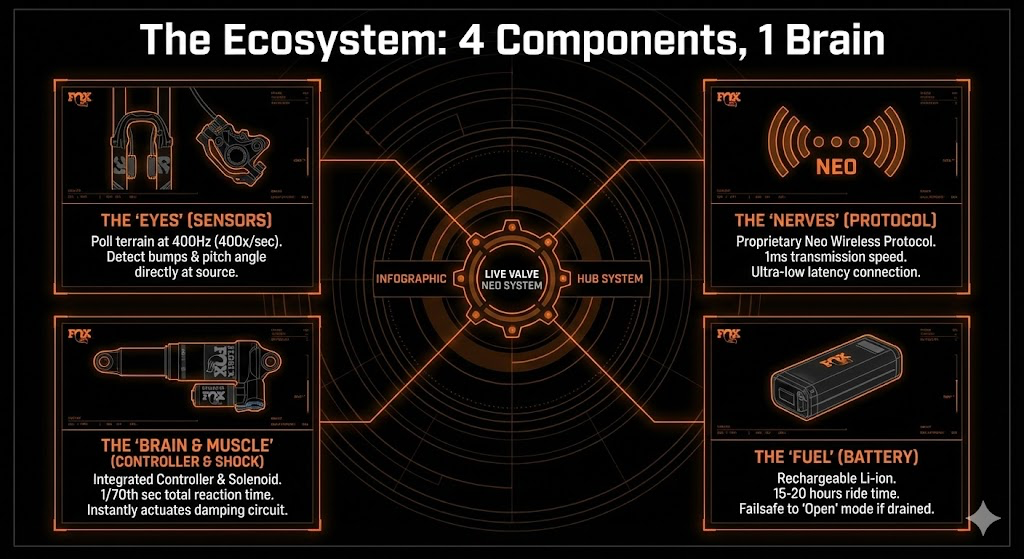
3. The Sensors: The Eyes of the Machine
The Neo Kit includes two sensors: one for the fork and one for the rear frame/brake assembly.
- Mounting Location: The sensors mount directly to the brake calipers (or frame near the caliper). This placement is deliberate. By mounting to the unsprung mass (the wheel/caliper assembly moves with the terrain, unlike the frame which is isolated by suspension), the sensors detect the ground input directly and immediately.1
- Technology: These are accelerometers that measure bump force (G-force) and pitch (angle).1 They poll the terrain at 400Hz (400 times per second).1
- Power: Each sensor runs on a CR2032 coin cell battery, with a claimed life of up to one year.1
4. The Controller & Battery
The Controller unit on the shock houses the solenoid, the Neo radio, and the rechargeable battery.
- Battery: A lithium-ion block identical to the one used in the Fox Transfer Neo dropper post.8
- Runtime: 15 to 20 hours of ride time.1
- Charging: USB-C via a proprietary dock.
- Status Indicators: An LED ring displays battery life and mode status.10
Part III: The Algorithmic Logic
How does the system decide when to open and when to close? Unlike RockShox Flight Attendant, which uses a pedal sensor to detect rider input, Live Valve Neo is terrain-centric.
The State Machine
The system operates based on three primary pitch states, determined by the inclinometers in the sensors:
- Climb: Nose pitched up.
- Flat: Neutral pitch.
- Descend: Nose pitched down.
The user calibrates “flat” during setup, establishing the baseline zero.4

The “Default Firm” Philosophy
The fundamental logic of Live Valve Neo is “Default Firm.” In Climb and Flat states, the solenoid is closed (Firm Mode) by default. The suspension is rigid and efficient. It only opens when a specific trigger event occurs:
- Bump Detection: If the accelerometer detects a G-force impact exceeding the set threshold (e.g., hitting a root), the Controller energizes the solenoid, retracting the latch and opening the oil circuit.
- Timer: Once open, a timer starts. If no further bumps are detected before the timer expires, the solenoid closes, returning the shock to Firm Mode. If another bump is hit, the timer resets.
In Descend mode, the logic inverts (or adjusts significantly depending on the tune). The bump threshold is lowered drastically, effectively keeping the shock active and open for maximum traction.8
Advanced Logic Features
- Freefall Detection: The accelerometers can detect 0G (weightlessness). If the bike is airborne, the system instantly opens the shock to prepare for landing.11
- Cornering: The sensors read sustained G-forces from cornering. The algorithm is smart enough to differentiate between a bump (vertical G) and a turn (lateral/sustained G). It can maintain support in a berm while remaining ready to absorb mid-corner chatter.
Part IV: Installation and Compatibility
One of the main selling points of Live Valve Neo is its aftermarket viability. We tested the installation process to verify the “DIY” claims.
The Physical Install
Installing the shock is as simple as swapping any rear shock. The complexity lies in the sensors.
- Front Sensor: Replaces one of the brake caliper mounting bolts. The kit includes specific bolts (M6x20mm and M6x42mm) to accommodate different adaptors.4
- Rear Sensor: Similarly mounts to the rear brake caliper.
- Compatibility Check: While Fox claims compatibility with “modern” brakes from Shimano, SRAM, TRP, and Magura 12, we discovered nuances.
- Hope Tech 4 V4: The large CNC-machined body and bleed port location of Hope brakes can interfere with the sensor body. On our test bike equipped with Hope V4s, we had to mount the sensor on the lower bolt rather than the preferred top bolt to clear the bleed nipple.1
- Magura: Generally compatible, but the angle of the banjo bolt on some MT7 setups can be tight.
- Frame Clearance: The reservoir on the Neo shock is longer and bulkier than a standard Float X. Riders with frames that have tight shock tunnels (e.g., Specialized Stumpjumper EVO, certain Transition Patrol sizes) must check the fitment guide carefully. Fox has noted that on a Small Transition Patrol, the reservoir contacts the frame at bottom out.13
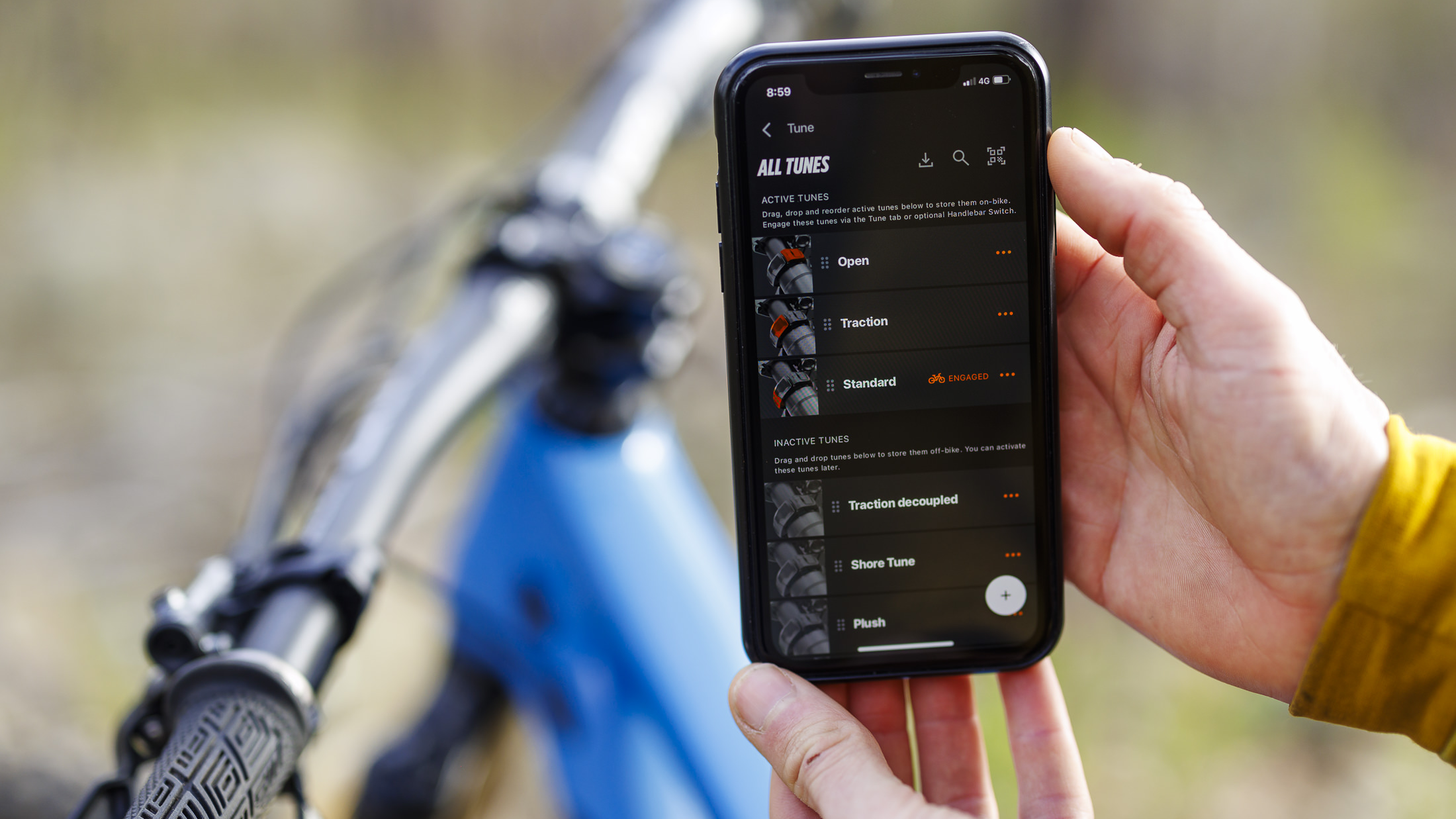
The Digital Setup (Fox Bike App)
Once the hardware is on, the Fox Bike App handles the rest.
- Pairing: Shake the components to wake them. The app scans and links them to a “Bike Profile.”
- Calibration: This is crucial. The bike must be on level ground. The app zeros the sensors. If this is done incorrectly (e.g., on a slight slope), the “Climb” and “Descend” transitions will be inaccurate.4
- Firmware Updates: The app pushes updates wirelessly. We performed an update during testing, which took approximately 3 minutes.
The app interface is clean and intuitive, a significant improvement over the older Live Valve app which was often criticized for connectivity bugs.
Part V: Testing Methodology
To provide a rigorous review, we established a testing protocol designed to isolate the variables of the system.
Test Platform:
- Bike: Orbea Rallon (160mm travel Enduro bike).
- Fork: Fox 38 Factory (Manual control).
- Shock: Fox Float X Live Valve Neo.
- Terrain: Pacific Northwest (Bellingham, WA).
The Test Loops:
- The Fire Road Climb: A consistent 12% grade smooth gravel climb to test pure efficiency and pedal bob elimination.
- The Tech Climb: A “janky,” root-infested singletrack climb requiring dynamic moves and traction.
- The Flow Descent: A machine-built jump trail with high-G berms and smooth transitions.
- The Raw Descent: A steep, natural track with rock gardens, drops, and high-frequency chatter.
Testing Logic:
We rode these loops in three distinct configurations:
- Baseline: System powered OFF (Defaults to Open). This sets the benchmark for the chassis kinematics.
- Standard Tune: The default factory settings for bump sensitivity and angle thresholds.
- Precision Tune: Customized settings via the app to test the range of adjustability.
Part VI: Ride Impressions – The Climb
The Fire Road Efficiency
Switching the system on at the bottom of the fire road, the change in character is immediate. The Orbea Rallon is a capable pedaler, but like all 160mm bikes, it settles into its travel under power. With Live Valve Neo active, the bike sits higher in its stroke. The sensation is not of a harsh lockout, but of a firm, supportive platform.
The “Firm Mode Adjust” dial on the shock allows for tuning this sensation. In the firmest setting (Position 6), the bike feels almost like a hardtail, translating every watt into forward motion. In the softer settings (Position 1-2), there is more compliance, but bob is still virtually eliminated.
Compared to reaching down for a climb switch, the mental freedom is significant. You simply pedal.
The Technical Climb: The “Magic Carpet” Effect
This is where the system justifies its price tag. On a technical climb full of wet roots and step-ups, a locked-out shock is a liability—it deflects off obstacles, causing the rear tire to lose traction. An open shock provides traction but saps energy. Live Valve Neo executes a magic trick here. As you approach a root step, you smash the front wheel into it. The fork sensor screams “Bump!” to the Controller. In the 14 milliseconds it takes the rear wheel to reach that same root, the shock has opened. You feel the rear wheel absorb the hit seamlessly, maintaining traction. Then, the moment the wheel clears the obstacle and you put down a power stroke to accelerate, the “Open Timer” expires, and the shock firms up. You are pushing against a solid platform, not a wallowing shock. This micro-management—opening for the hit, closing for the pedal stroke—happens dozens of times per minute. The result is that you arrive at the top of technical climbs with noticeably more energy and having cleared sections that usually stall a long-travel bike.8
Part VII: Ride Impressions – The Descent
The Transition
As you tip the bike into the descent, the pitch sensor detects the negative gradient. The system switches to Descend State. In this state, the bump threshold is lowered, meaning even the smallest ripple will open the valve.
Silence and Speed
The most remarkable aspect of the descent is silence. The solenoid actuation is inaudible. Unlike the “zip-zip” whir of the RockShox Flight Attendant motor, the Fox system is ghostly quiet.8 On high-speed chatter (braking bumps), the system stays open. The “Open Timer” resets with every bump, so a rapid succession of hits keeps the valve effectively pinned open. The Float X performs as a world-class damper should—supple, controlled, and composed. There is no sensation of “spiking” or harshness caused by the electronics “thinking.” The 1ms reaction speed is faster than the hydraulic fluid can displace.
Flow Trails and Pumping
On smooth jump trails, the system’s “Default Firm” logic (if tuned correctly) adds a new dimension. On smooth straightaways between jumps, the shock firms up. This allows you to pump the terrain, generating speed from rollers and transitions that would normally be absorbed by suspension squish. When you hit the lip of a jump, the G-force opens the shock, but the “Firm Mode” can be tuned to provide a solid platform for popping off the lip. The “Freefall” detection ensures that by the time you land, the shock is open and ready to absorb the impact. We never experienced a harsh landing, even when landing deep or short.11
Cornering Support
In high-speed berms, the bike feels incredibly supported. Because the system can differentiate between a sharp vertical impact and a sustained lateral G-force, it doesn’t collapse into the travel mid-corner. It holds the rider up, preserving geometry and exit speed.15
Part VIII: The App Deep Dive – Precision Tuning
For the “set and forget” rider, the Standard Tune works brilliantly. But for the “tinkerer,” the Fox Bike App offers the Precision Mode, which unlocks the full potential of the algorithm.16
Tuneable Parameters
- Bump Sensitivity Threshold: This is a slider (1-10) that sets how hard of a hit is required to open the valve.
- Testing Insight: We found that increasing sensitivity in “Climb” mode made the bike too active on smooth fire roads, reacting to rider weight shifts. Dialing it back created a more distinct platform.
- Open Timer: This controls how long the shock stays open after a hit.
- Testing Insight: On the “Raw Descent,” extending the Open Timer ensured the shock didn’t try to firm up in the brief milliseconds of air time between rock garden impacts, creating a smoother, more consistent feel.
- Climb/Descend Angle: You can set the exact degree of tilt that triggers the modes.
- Testing Insight: If you ride steep climbing trails, increasing the Climb Angle threshold prevents the bike from thinking it is climbing when you are actually on a flat traverse, or vice versa.
The app also features a “Service” tab that tracks hours ridden. It notified us exactly how many hours we had put on the shock, helping to adhere to the 125-hour service interval.1
Part IX: Comparative Analysis – The Battle of the Titans
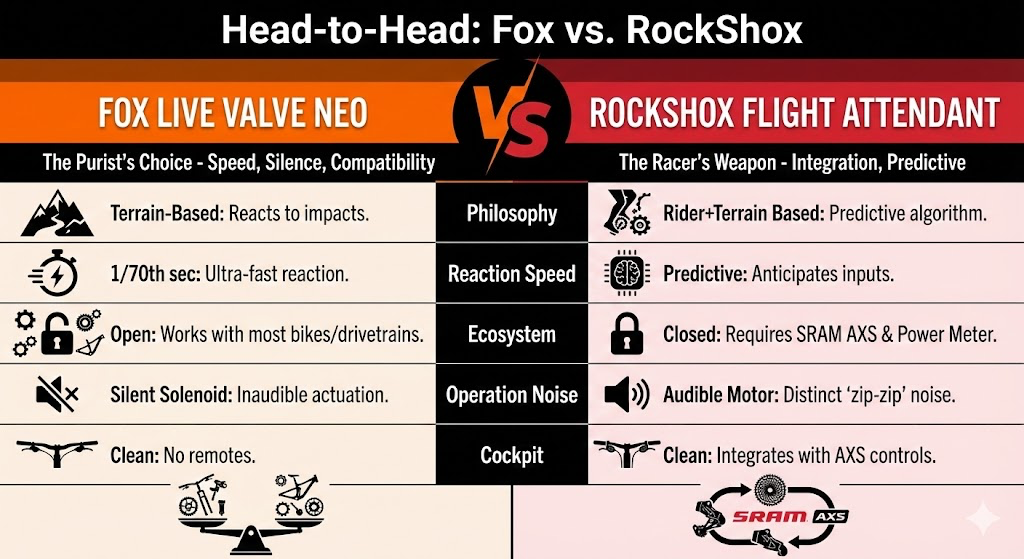
The inevitable comparison is against RockShox Flight Attendant.
| Feature | Fox Live Valve Neo | RockShox Flight Attendant |
| Philosophy | Terrain-Based: Reacts to impacts. | Rider-Based: Reacts to pedaling effort & terrain. |
| Fork Control | No: Rear shock only. | Yes: Controls Fork & Shock. |
| Ecosystem | Open: Works with any components. | Closed: Requires SRAM AXS drivetrain & Power Meter. |
| Reaction Speed | 1/70th sec: Extremely fast. | Predictive: Uses algorithm to anticipate. |
| Noise | Silent: Magnetic solenoid. | Audible: Motor noise. |
| Installation | Easy: 2 sensors + shock. | Complex: Full drivetrain + suspension swap. |
| Price | ~$1,400 (Kit + Shock). | ~$2,800+ (Fork + Shock + Drivetrain upgrades). |
The Verdict on Comparison
- Fox Live Valve Neo wins on simplicity and speed. It is faster to react to a surprise impact. It is easier to live with because it doesn’t force you to run specific cranks or derailleurs. It is the better choice for the Enduro/Trail riderwho prioritizes descending performance and wants a “magic switch” for the climbs.
- RockShox Flight Attendant wins on integration. By controlling the fork and knowing your power output, it is the superior weapon for XC Racing, where a locked fork is essential for sprinting efficiency.17
Part X: Durability, Livability, and Economics
The Elements
We tested the system in typical Pacific Northwest conditions—mud, rain, and grit. The IPX7 rating held true. We experienced no connectivity dropouts or water ingress. The charging port on the Controller is well-sealed with a rubber gasket.
Battery Life
The 15-20 hour claim is accurate. In our testing, a 3-hour ride consumed roughly 15-20% of the battery. The LED indicator on the shock (Green/Amber/Red) gives a clear warning. The sensors, with their 1-year lifespan, are effectively a non-issue, though carrying a spare CR2032 in your pack is wise.
- Failsafe: We intentionally drained the battery to test the failsafe. As promised, when the battery died, the solenoid latched open. The bike rode like a standard, plush, open Float X. You are never stranded with a locked shock.1
The Financial Reality
Pricing Breakdown:
- Live Valve Neo Kit: ~$419 – $449 USD.19
- Float X Live Valve Neo: ~$999 USD.1
- Total: ~$1,420 USD.
This is a significant investment. For the price of this system, you could buy a high-end carbon wheelset or a riding trip to Whistler.
- Is it worth it?
- YES: If you have a long-travel bike that you love descending on but hate climbing with. This system effectively gives you two bikes in one. It widens the operating window of an enduro bike significantly.
- NO: If you ride a short-travel bike that already pedals well, or if you are on a tight budget. The marginal gains on a 120mm bike are less transformative than on a 170mm bike.
Part XI: FAQs
Q: Does Live Valve Neo work with coil shocks?
A: Yes, the DHX Live Valve Neo is specifically designed for this. It is arguably the best application of the tech, solving the inherent inefficiency of coil springs.
Q: Can I install it myself?
A: Yes. If you can change a shock and a brake bolt, you can install this. The app guides you through pairing and calibration.
Q: Does it work with E-Bikes? A: Yes. It is compatible with E-MTBs. In fact, the efficiency gains can help extend battery range by reducing suspension bob.8
Q: What if I have Hope Brakes? A: You may encounter clearance issues with the sensor on the front caliper due to the bleed port. You might need to mount it on the lower bolt or use a spacer/adapter. Check forums and Fox’s fitment guide carefully.6
Q: Does it clutter the cockpit?
A: No. That is the beauty of it. There are zero handlebar remotes. Your cockpit remains clean.
Q: Can I use the Transfer Neo dropper battery? A: Yes, the batteries are interchangeable.8
Part XII: Final Verdict
The Fox Live Valve Neo is a technological tour de force. It successfully executes the promise of electronic suspension: making the bike more efficient without requiring rider thought.
By decoupling the suspension’s firm mode from the rider’s mental load, it allows you to focus entirely on the trail. You pedal harder because the bike feels efficient. You descend faster because the suspension is always active when it needs to be.
The “Neo” wireless protocol proves that wireless can be faster than wired in practical application. The reaction speed is instantaneous, the operation is silent, and the integration is seamless. While the price of entry is high, for the rider seeking the ultimate performance upgrade for their trail or enduro bike, Live Valve Neo is currently in a class of its own. It is not just an upgrade; it is an evolution of the mountain bike.
| Pros | Cons |
| Instantaneous Reaction: 1ms Neo protocol is incredibly fast. | High Cost: Significant investment (~$1,400 USD). |
| Silent Operation: Inaudible solenoid actuation. | Added Weight: Heavier than a standard mechanical shock. |
| Universal Compatibility: Works with almost any modern frame and drivetrain. | Fitment Issues: Potential clearance problems with some brakes (Hope) or tight frames. |
| Clean Cockpit: No handlebar remotes or extra wires. | Another Battery: Requires management and charging. |
| “Magic Carpet” Ride: Efficient climbing platform that instantly opens for bumps. | Charging Required: 15-20 hour battery life means regular charging. |
| Intuitive App: Easy setup with powerful tuning options for enthusiasts. | |
| Failsafe Mode: Shock defaults to “Open” if the battery dies. |