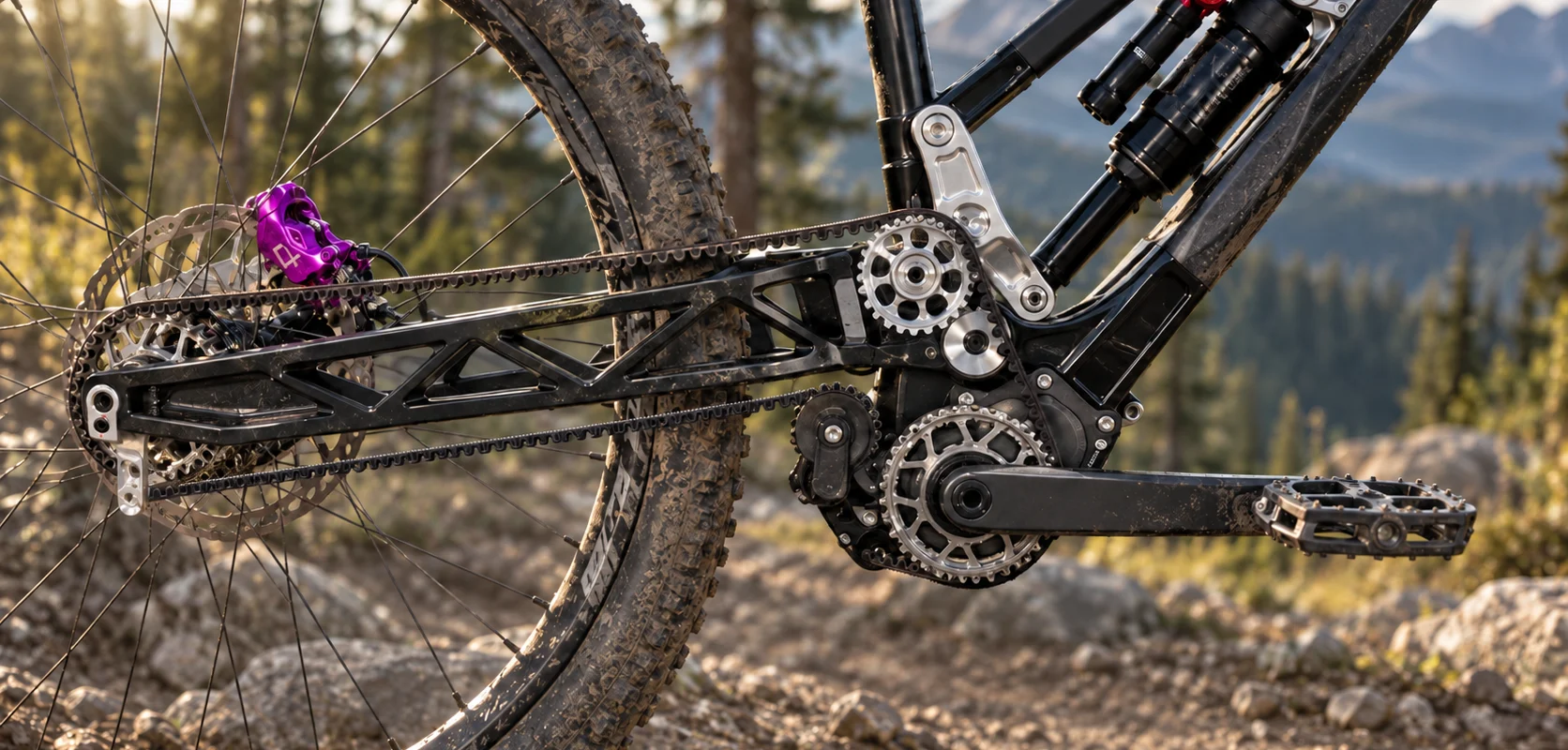
A gearbox bike is not a gimmick built for gravel commuters and touring cyclists who hate cleaning chains. That’s the assumption a lot of racers and shop rattlers have carried for years, and Hattie Harnden just put a dent in it at Les Gets. On August 23, 2026, Harnden won a UCI Downhill World Cup round on an AON Racing Gamux Sego running a 12-speed Pinion gearbox and a Gates Carbon Drive belt [1][2]. It’s the first elite World Cup downhill win ever recorded on a belt-driven, gearbox-equipped bike [3][4][5].
If you follow gear trends even loosely, this is the kind of result that changes conversations at the trailhead. But it shouldn’t change your next bike purchase just yet, and here’s why.
What Actually Happened at Les Gets
Harnden qualified third and then won the final, a jump that’s tough to pull off on any bike, let alone one running hardware most privateers have never touched [1]. The win pushed her to second overall in the season standings [1]. That’s a real result against a full elite field, not a demo run or a sponsor stunt.
The conditions mattered too. Les Gets was muddy and changing fast during the race weekend, the kind of course where chains skip, derailleurs clog, and small mechanical failures end runs [3]. A sealed gearbox and a belt that doesn’t care about grit have an obvious edge in exactly that scenario. Harnden said as much herself, crediting the belt drive for “smooth consistency without dropped chains or skipped gears,” which let her focus on the run instead of her drivetrain [6].
There’s also money on the table that makes this more than a nice headline. Gates had offered a €100,000 “Belted Purse” bounty (reported around $116,000) for the first elite win on its belt technology, and it had gone unclaimed for roughly two years before Harnden collected it [4]. That’s not a marketing number pulled from thin air. It’s a prize that sat there, unclaimed, while teams tried and failed to win on this setup.
Why This Is a Big Deal, Even If You Never Race
Gearbox and belt systems have been the “someday” technology in mountain biking for a long time. They show up on touring bikes, the occasional bikepacking rig, and a handful of curious trail builds. Racing is different. Racing is where weight, speed, and reliability get tested under conditions no weekend rider will ever push a bike through.
A win at this level tells you the technology survived that test. It’s proof of concept in the most literal sense: gearboxes and belts can win, not just finish, at the top of the sport. AON Racing’s own race report called the result “monumental,” specifically because it was the first elite victory on belt-driven tech [1].
Here’s the part that matters for your buying decision, though. One win is a data point, not a trend line. BikeRadar, covering the same result, was blunt about it: “there hasn’t been a wholesale shift in the results sheets” [7]. That’s a fair read. Plenty of technology has looked unstoppable after one big race weekend and then faded quietly back into the niche column.
The Trade-Offs Nobody’s Marketing Department Will Lead With
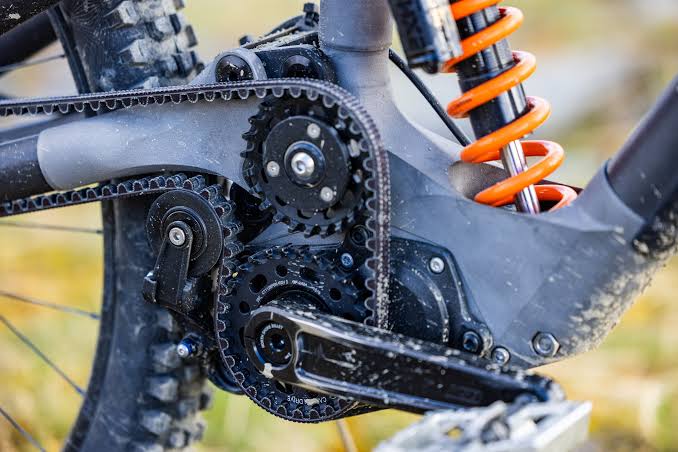
Before you start pricing out a gearbox build, look at the weight numbers. A Pinion C1.9 gearbox weighs about 2,000 grams. A SRAM GX Transmission derailleur and cassette setup weighs around 915 grams [8]. That’s roughly a 1.1kg penalty sitting low and central on your frame [8]. For downhill, where the mass sits close to the bottom bracket, that’s manageable. For anything where you’re pedaling uphill under your own power, it’s a real cost.
Maintenance is where the story flips in the gearbox’s favor. Pinion recommends an oil change every 6,000 miles, and there’s no chain to clean or lube on a regular basis [8]. Gates belts are rated to last 2.5 to 3 times longer than a chain, up to 30,000 km in comparable conditions, and they shrug off rust and salt with almost no upkeep. If you ride in mud, sand, or winter slop on a regular basis, that durability gap is not a small thing.
So which matters more to you, the extra kilogram or the drastically reduced wrench time? That’s really the question every rider has to answer for themselves, and the honest answer depends entirely on what kind of riding you do.
- Weight penalty: about 1.1kg heavier than a modern derailleur setup [8]
- Maintenance: oil change every 6,000 miles, no routine chain cleaning [8]
- Belt lifespan: up to 30,000 km, 2.5 to 3x a standard chain
- Adoption: four top teams currently racing DH on gearbox bikes [1]
Adoption Is Real, But It’s Still Narrow
Four top teams are currently racing downhill on gearbox bikes, according to BikeRumor’s reporting [1]. That’s meaningful momentum in a sport where teams don’t switch platforms lightly. It also means the vast majority of the World Cup field is still running conventional derailleurs. Four teams out of a full grid is a signal, not a stampede.
Frame design is a big part of why. Gearbox and belt systems require a bike built around them from the start, split frames for belt routing, specific pivot placement, and a completely different suspension layout in most cases. You can’t just bolt this system onto an existing enduro frame and call it done. That kind of commitment is expensive for a brand to make on a platform that’s still proving itself race weekend by race weekend.
The Bike That Turns This Into a Buying Decision
Race tech staying in the pits is one thing. Race tech showing up in a bike you can actually buy is another, and that’s already happening. Days before Harnden’s win, Nicolai unveiled the R20 MGU AON Edition, a commercial self-shuttle downhill eMTB directly derived from the Sego platform’s geometry and kinematics [9][10].
The R20 runs a Pinion MGU E1.12 integrated motor-gearbox unit putting out up to roughly 160 Nm of torque, paired with a battery option up to 1060 Wh [9]. All that hardware brings total weight to around 29.5 kg, which is heavy even by eMTB standards [9]. This is not a bike built to be light. It’s built to survive repeated shuttle-free descents without babying a drivetrain between runs, and the race-proven kinematics behind it are exactly what just won at Les Gets.
What This Means for Your Next Bike
If you’re shopping for a lightweight trail bike you’ll pedal uphill more than you’ll shuttle down, this win doesn’t change much for you yet. The weight penalty is real, the frame ecosystem is still limited, and the parts network for gearbox systems is nowhere near as deep as SRAM or Shimano’s derailleur lineup.
If you’re riding a bike park regularly, racing enduro in wet climates, or building a self-shuttle downhill rig where weight matters less than reliability, the case gets a lot stronger. The maintenance savings alone could be worth the setup cost over a season of riding in bad conditions. This is the honest, unsponsored read: a credible breakthrough, not a wholesale changeover. Treat it as proof the technology works at the highest level, not as a signal every bike in your garage needs a belt.
Frequently Asked Questions
Is a gearbox bike better than a derailleur bike for downhill racing?
Neither is universally better. Gearbox and belt setups showed a real advantage in muddy, chaotic conditions at Les Gets [3], but only four top teams currently race them [1], meaning most riders and teams still trust derailleurs for weight and familiarity reasons.
How much heavier is a Pinion gearbox than a standard drivetrain?
A Pinion C1.9 gearbox weighs about 2,000 grams compared to roughly 915 grams for a SRAM GX Transmission derailleur and cassette, a difference of about 1.1kg [8].
How often do you need to maintain a Pinion gearbox and Gates belt?
Pinion recommends an oil change every 6,000 miles with no routine chain cleaning needed [8]. Gates belts can last 2.5 to 3 times longer than a chain, up to 30,000 km under comparable conditions.
Can I buy a bike with the same tech Hattie Harnden raced?
Not the exact race bike, but the Nicolai R20 MGU AON Edition uses the same Sego platform kinematics with a Pinion motor-gearbox unit and Gates belt drive, giving riders a commercial version of the concept in a self-shuttle downhill eMTB [9][10].
Keep an eye on how many teams show up to the next World Cup round on gearbox bikes. That number, more than any single win, will tell you whether this is the start of something or a very well-timed highlight. We’ll be watching the start lists and testing whatever shows up on trail, because that’s the only way to know if the hype holds up.
Sources
- Hattie Harnden’s €100K Winning AON Gamux Sego: Pro Bike Raced to Gates Belted Purse (bikerumor.com)
- Downhill World Cup 2026 – Les Gets Hattie, Hattie, Fahrradkettie(mtb-news.de)
- First Ever DH Win on a Belt-Driven Bike Notched(bikeworldnews.com)
- A rider on a belt-driven bike wins a mountain-bike world series race for the first time—and €100,000 (stocktitan.net)
- World Cup Victory on a Bike with a Gear System (all-about-industries.com)
- British racer claims €100,000 Gates Belted Purse with historic DH win (singletracks.com)
- Does Hattie Harnden’s €100,000 win prove belt drives have a bright … (bikeradar.com)
- Gearbox bikes have conquered DH and now enduro. Trail …(singletracks.com)
- “It’s not meant to be rational” – Nicolai’s R20 is an electric downhill bike with a 12spd gearbox and a monster battery | BikeRadar(bikeradar.com)
- NICOLAI R20 MGU AON Edition: A True Downhill E-Bike(pinion.eu)
Researched from 24 vetted sources · average source authority DR 68

I founded Bike198 back in 2008 and started riding bikes seriously in 1994. A lot has changed since that time and one of the greatest releases is still getting out on the bike and shredding trail or tearing up the road.
 From the Bike198 shopBIKE198 - Mesh Snapback$29Shop