
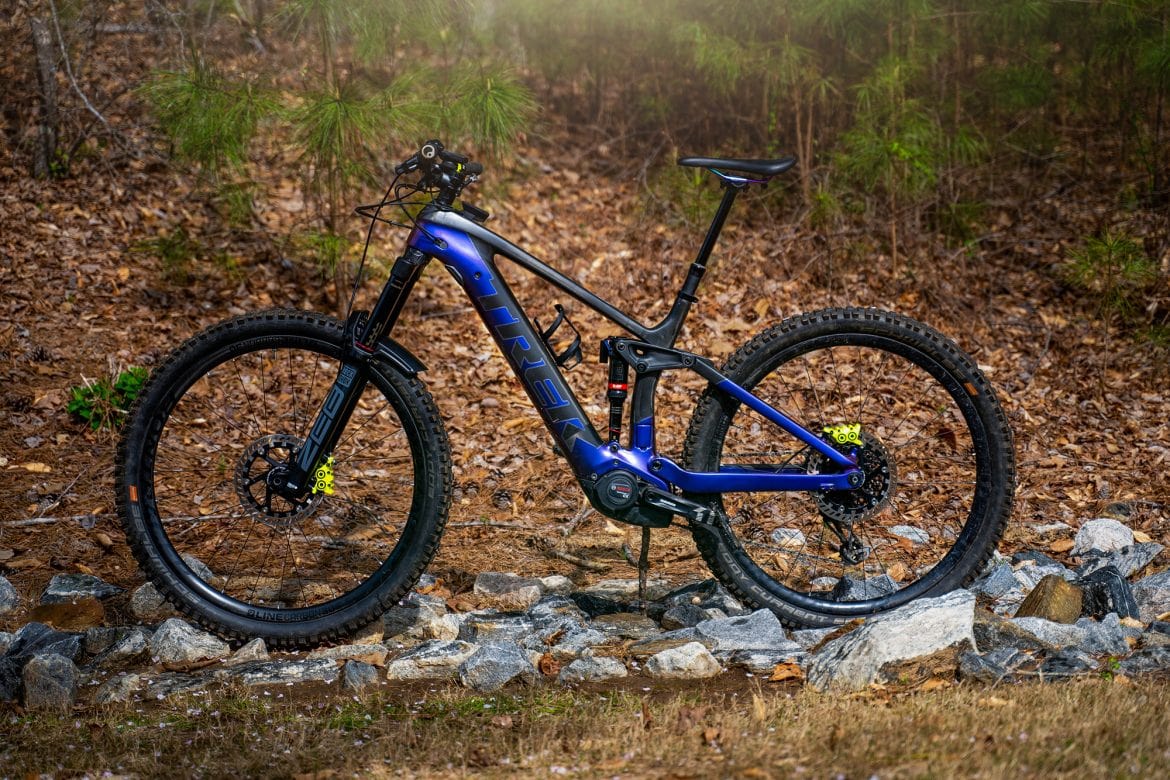
Electric bikes and electric dirt bikes are exploding in popularity—but the confusion around where you can ride each one has grown just as fast. On the surface, a Trek Rail and a Surron Light Bee X both look like off-road, electric two-wheel machines. They have suspension, knobby tires, and a battery. They’re fun. They’re fast.
But they are not the same category of vehicle, not legally, not socially, and not in terms of design intent.
This guide breaks it all down clearly—so you can explain the difference to friends, trail users, land managers, or anyone who thinks “all e-bikes are the same.”
Quick Comparison Table
| Feature | Class 1 E-MTB (Trek Rail) | Electric Dirt Bike (Surron) |
|---|---|---|
| Motor Type | Pedal-assist only | Throttle-powered |
| Power Output | ~250W nominal, ~600W peak | 3,000–6,500W (stock to modded) |
| Top Speed Assist | 20 mph | 45–60+ mph |
| Weight | 45–55 lbs | 105–130 lbs |
| Legal Classification | Bicycle | Motor vehicle / off-highway vehicle |
| Trail Access | Many MTB trails allow Class 1 | MTB trails never legal |
| Ideal Terrain | MTB singletrack | MX tracks, OHV trails, private land |
| Primary Purpose | Enhance mountain biking | Replace gas dirt bikes |
1. Technical Differences: What These Machines Are Actually Built For
Electric mountain bikes and electric dirt bikes share some surface similarities, but the underlying technology is radically different.
1.1 Motor Power & Delivery
Class 1 E-MTB (Trek Rail)
- 250W nominal (federally regulated limit for an e-bike)
- Pedal-assist only, no throttle allowed
- Cuts off assistance at 20 mph
- Power delivery is smooth and torque-limited to feel like enhanced mountain biking
- Requires rider input for all motion—no pedaling, no movement
Electric Dirt Bike (Surron)
- 3,000W stock, 6,000–10,000W+ with mods
- Full-throttle motorcycle-style power
- Capable of 45–60+ mph depending on tuning
- Motor torque is exponentially higher
- Can accelerate from 0 without pedaling
Bottom line:
A Trek Rail amplifies your pedaling.
A Surron replaces pedaling entirely.
1.2 Chassis, Suspension & Components
Class 1 E-MTB
- Built on MTB frames (aluminum or carbon)
- Suspension designed for ~50 lb bike weight
- MTB drivetrain, brakes, tires
- Geometry optimized for pedaling and technical singletrack
- Limited by bicycle standards: ISO 4210
Electric Dirt Bike
- Motorcycle-grade chassis
- Moto-style suspension with longer travel
- Motorcycle brakes and drivetrain components
- Much larger axles, wheels, and hubs
- Built to withstand high-speed impacts and torque loads
- Classified as OHV/motorcycle for safety standards
Think of a Class 1 E-MTB as a mountain bike with a small assist.
Think of a Surron as a lightweight motorcycle with pedals removed.
1.3 Weight & Handling
- Trek Rail: ~50 lbs
- Surron: ~110 lbs
This matters for braking distance, cornering, trail damage, and rider control—even before we get into legality.
2. Legal Differences: Where You Can and Cannot Ride
This is the biggest and most misunderstood distinction.
From a land manager or law enforcement perspective, these two machines live in entirely different regulatory universes.
2.1 How Class 1 E-MTBs Are Classified in the U.S.
Most U.S. states have adopted a 3-Class e-bike system:
- Class 1: Pedal assist only, 20 mph max (Trek Rail)
- Class 2: Throttle, 20 mph max
- Class 3: Pedal assist, 28 mph max
Class 1 is the only category broadly approved for MTB trail use.
Where Class 1 E-MTBs Are Commonly Allowed
- Municipal trail systems
- State parks
- Many purpose-built mountain bike networks
- Some NICA/National MTB racing venues
Where Class 1 Access Is Restricted
- Certain National Forest and BLM lands (rules vary by district)
- Non-motorized wilderness areas
- Some IMBA-affiliated trail systems
- Some federal lands still classify all e-bikes as motor vehicles
Most MTB-accessible lands now provide explicit signage or interactive maps.
But the trend is clear:
Class 1 E-MTBs are increasingly accepted on non-motorized trails where traditional bicycles are allowed—as long as they follow the rules.
2.2 How Electric Dirt Bikes (Surron) Are Classified in the U.S.
Surron-type vehicles are legally considered motor vehicles or off-highway vehicles (OHVs) because they have:
- Motorcycle-level power
- Throttle
- No speed limiter to 20 mph
- No pedal-assist function
- Higher weight and torque
Where Electric Dirt Bikes Are Not Allowed
These areas legally prohibit Surrons:
- Mountain bike trails (100% illegal)
- Shared-use path systems
- City greenways & bike lanes
- Non-motorized trail networks
- Hiking trails
- State parks’ bicycle trails
Where They Are Allowed
- OHV/moto trails
- Motocross tracks
- Private land
- Some desert riding areas
- Some BLM motorized-use zones
- State OHV parks
Permitting Requirements
In many states, Surron riders must:
- Obtain an OHV sticker/permit
- Use an OHV-approved area
- Follow motor vehicle rules
- Transport legally (some states require plates for road crossings)
Legal Consequences for Riding a Surron on MTB Trails
Penalties vary but commonly include:
- Fines ($100–$500+)
- Confiscation
- Trail access bans
- Charges for trespassing or operating an unregistered OHV
This is not theoretical—many U.S. trail systems have already issued citations.
3. Social Perspectives: Why the Community Treats These Machines Differently
Even when people understand the technical and legal distinctions, the social perception piece is just as important.
3.1 Class 1 E-MTBs in the MTB Community
Generally seen as:
- Trail-appropriate
- Human-powered (with assistance)
- Similar speed to strong riders
- Low weight compared to motos
- Leaving comparable trail wear
- Accessible for aging or recovering riders
Class 1 e-MTBs can still create debate, but the majority of modern MTB communities have accepted them as bikes.
3.2 Electric Dirt Bikes in the MTB Community
Surrons are widely viewed as:
- Directly unsafe due to speed differential
- Too heavy for narrow trails
- Too powerful for blind corners
- Causing moto-style trail degradation
- Eroding access for cyclists
- A potential threat to MTB trail networks if land managers see them as “motorized encroachment”
Even responsible Surron riders get grouped into this perception.
Bottom Line:
MTB communities are trying to protect trail access. Allowing motos—electric or otherwise—onto non-motorized singletrack threatens that access.
3.3 How Surron Riders Can Avoid Conflict
- Stick to OHV-designated areas
- Avoid mixed-use MTB trail systems entirely
- Don’t ride on public greenways unless explicitly allowed
- Advocate for electric moto areas at local OHV parks
- Keep speeds appropriate and avoid social media videos of illegal riding
4. Purpose & Riding Experience: What Each Machine Is Actually For
Class 1 E-MTB (Trek Rail)
Built to enhance the mountain bike experience:
- More laps
- More climbing
- Same line choice, same technique
- Fitness remains part of the equation
- Integrates into existing MTB culture
Electric Dirt Bike (Surron)
Built to replace or supplement traditional gas dirt bikes:
- High-speed trail ripping
- Jumps, berms, moto terrain
- MX-style riding
- No pedaling required
- More adrenaline, more power, different skill set
One does not replace the other—they serve different riders and styles.
5. Which One Should You Get?
Get a Class 1 E-MTB If:
- You want to ride MTB trails
- You value technical singletrack
- You enjoy pedaling but want more laps
- You need extra help with climbing
- You want legal access to the largest possible trail network
Get a Surron If:
- You have access to OHV trails or private land
- You want a lightweight dirt bike experience
- You prefer throttle-powered riding
- You’re replacing or supplementing a gas moto
- You don’t care about pedaling or MTB culture
6. FAQ (SEO Fuel)
Is a Surron an e-bike?
No. It is a motorcycle/OHV in legal terms.
Can you ride a Surron on mountain bike trails?
No. 100% illegal in nearly all U.S. jurisdictions.
Is a Trek Rail legal on MTB trails?
Yes—on most trail systems that allow Class 1 pedal-assist e-MTBs, but users must check local rules.
Does a Class 1 E-MTB damage trails more than a normal MTB?
Current research shows trail impact is similar when speeds are comparable.
Which is faster?
A Surron—by a massive margin.
Which gives a better workout?
The Trek Rail, because pedaling is required.
Conclusion
A Class 1 E-MTB like the Trek Rail and an electric dirt bike like the Surron may appear to be part of the same electric revolution—but they live in entirely different worlds.
- Different power levels
- Different legal classifications
- Different allowed riding areas
- Different cultural acceptance
- Different purposes
One is a bicycle.
The other is a motorcycle.
Understanding that distinction is essential—not just for staying legal, but for maintaining access to the trails all of us love.
2 comments
Clear and concise information. Thanks for doing this.
Very helpful summary. Thanks.