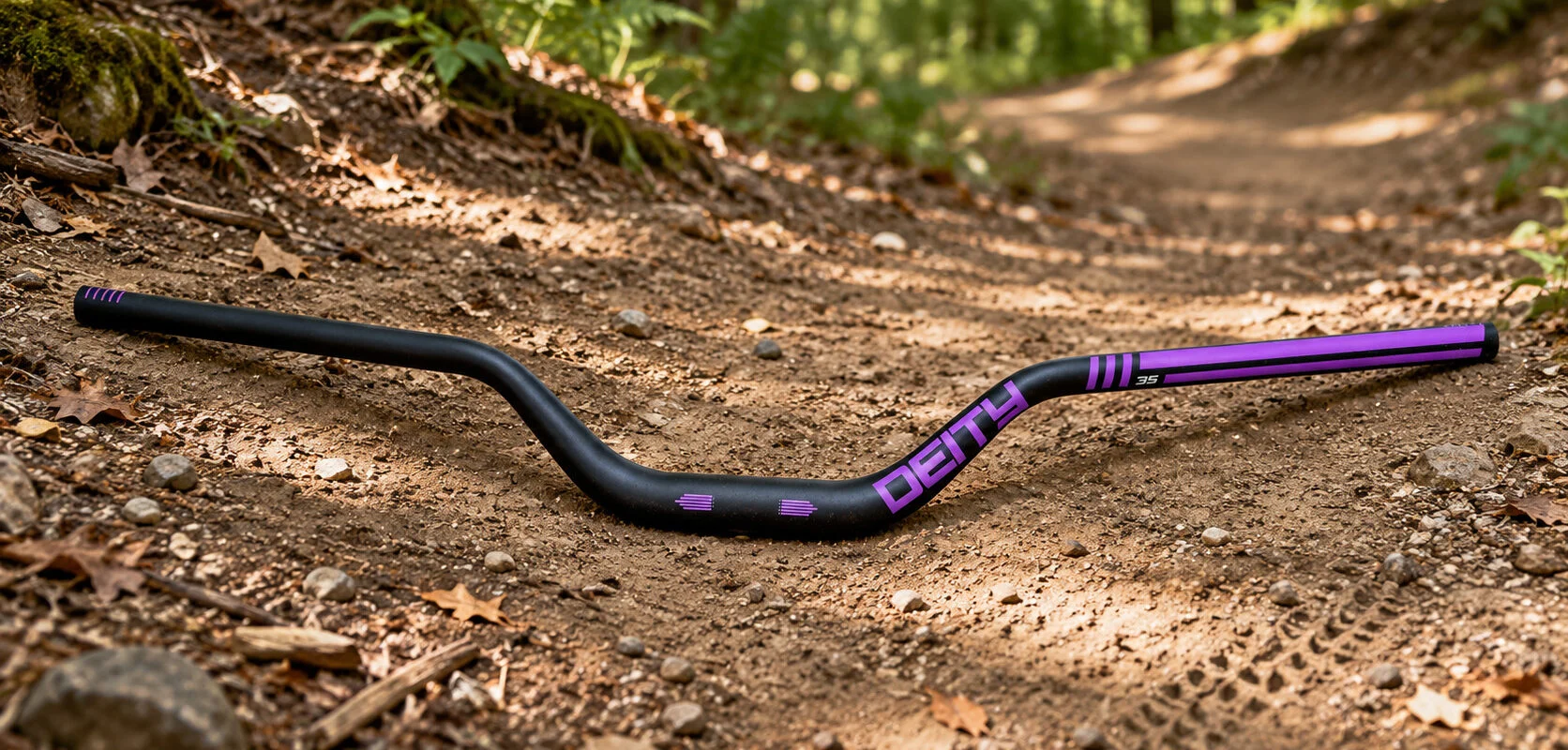
Would you run a handlebar with 80mm of rise on your trail bike? Before you laugh that off, know this: Deity’s Highside comes in a 35x800mm version that clamps at exactly that height, and it’s not some fringe product from a garage brand chasing likes [1]. It’s a real answer to a question more riders are asking. Standard riser bars sit at 25 to 38mm of rise. Deity’s own Ridgeline, a “normal” riser from the same catalog, tops out at 25mm on an 800mm-wide bar.
The Highside more than triples that on its tallest option. So the question isn’t whether Deity can build a tall bar. It’s whether you should be riding one.
Check out the latest pricing at JensonUSA –> Deity Highrise Handlebar (All colors)
What “80mm of Rise” Actually Means on the Trail
Rise measures how far the grips sit above the bar’s center clamp point. Most trail and all-mountain bars cluster in that 25 to 38mm window, which puts your hands at a height that’s worked for two decades of mountain bike geometry. Deity offers the Highside in two forms: a 31.8mm clamp version at 760mm wide with 50mm of rise, and a beefier 35mm clamp version at 800mm wide with 80mm of rise. That’s not a small step up. It’s a jump into territory usually reserved for outlier builds aimed at very tall riders or riders solving a specific fit problem [2].
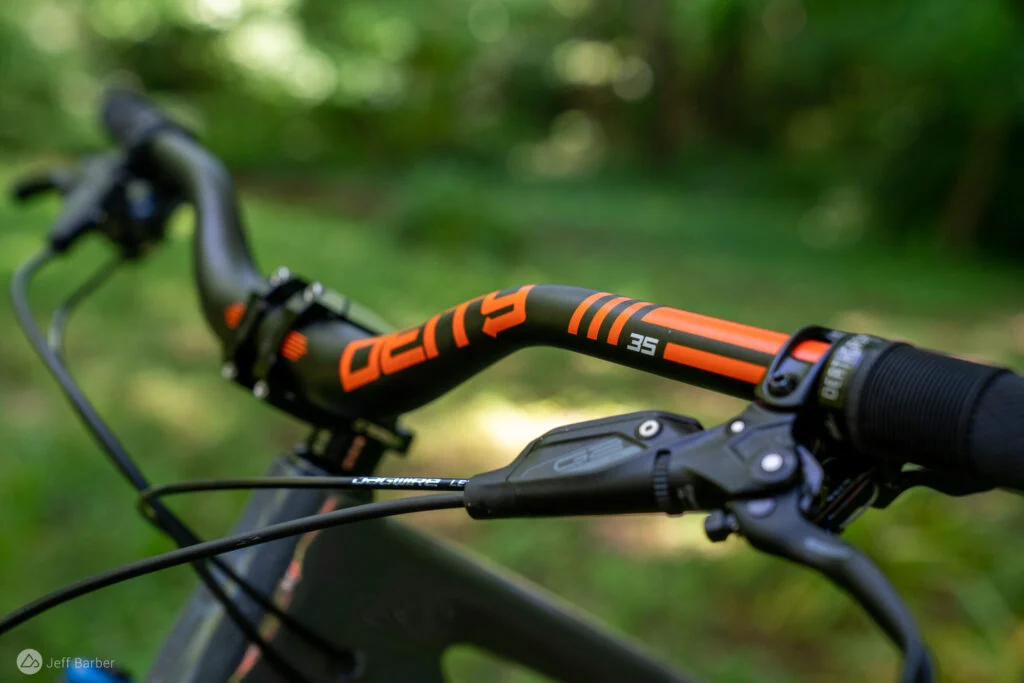
Standard fit guidance says bars should sit level with the saddle, or at most 30mm below it. High-rise bars deliberately blow past that rule. Deity’s own product language for the 80mm Highside says the width “provides stability and control in technical terrain,” while the rise “helps reduce upper body load,” and the 35mm clamp “ensures stiffness and good steering response.” That’s the brand’s pitch. Whether it holds up depends entirely on your body, your bike, and your terrain.
Why Rise Is Suddenly a Bigger Deal Than Width
For years, the cockpit conversation was mostly about width and sweep. Now rise has become its own variable, and it’s escalating fast. Some racers and product engineers are exploring “reverse reach” stem designs that shift how stack and reach interact with rise entirely, which shows how much attention this part of the bike is getting right now [3]. High-rise bars are being marketed less as a style statement and more as a load-management tool, something that changes how your arms, shoulders, and wrists absorb terrain over a long descent [4].
At the same time, stems have gone the opposite direction. Trail and enduro bikes now ship stock with 35 to 50mm stems, a real departure from the 60 to 80mm stems that used to be standard even outside of XC builds [5]. Hope’s Gravity stem takes that trend to an extreme at just 20mm long, and it lifts the bar 35mm on its own, stacking short-reach geometry with added height in a single part [6]. Hope’s related Stummel stem follows the same logic, using increased stack height to change how an enduro bike handles rough terrain [7]. None of this happened by accident. Frame designers are building bikes around short stems from the start, not treating them as an aftermarket swap. Rise and reach are now two ends of the same fit equation, and Highside sits at the tall extreme of that equation.
 From the Bike198 shopIs My Bike Ok?$26Shop
 The Case For Going Tall
Here’s what a taller bar actually does on the trail. It raises your chest and shortens the distance your arms have to reach down to the grips. On steep, chattery descents, that changes your weight distribution enough that some riders feel noticeably less strain in their hands and forearms by the bottom of a long run [4]. A German test of high-rise setups found real gains in control on technical terrain, though the same testers were careful to separate genuine performance benefit from marketing hype around the trend [8].
There’s also a body-size argument here that gets overlooked. Taller riders often end up compensating for frame stack limitations by cranking their stems up with spacers, which isn’t always clean or stiff. A bar built with 50 to 80mm of rise solves that problem at the cockpit instead of the headset, and it does it with the stiffness of a proper 35mm clamp rather than a tower of spacers under a shorter stem. If you’re 6’2″ and tired of running your stem slammed against a stack of washers, Highside is a legitimate fix, not a gimmick.
- Reduces forward lean and hand pressure on long, rough descents [4]
- Solves fit problems for taller riders without stacking spacers
- Pairs naturally with the shorter stems now standard on trail and enduro frames [5]
- Keeps the stiffness of a 35mm clamp instead of relying on excess steerer height
Check out the latest pricing at JensonUSA –> Deity Highrise Handlebar (All colors)
The Case Against It
Now for the other side, because this bar isn’t free of tradeoffs. World Cup downhill racers, the riders who care most about raw control at speed, remain split on where bars should sit in the stack, and plenty of them still favor lower front ends for high-speed stability rather than height for comfort [9]. That split matters. If the fastest riders in the sport haven’t settled on “taller is better,” you shouldn’t assume it either.
Shorter stems, which the Highside is basically designed to be paired with, quicken steering and take weight off your hands, but they can also make the front end feel light and twitchy, especially on climbs or at speed [10]. Add 80mm of rise on top of that and you’re stacking two changes that both alter your weight balance in the same direction, away from the front wheel. If you’re someone who already fights front-end wander on steep climbs, this combination could make that worse, not better. A bar this tall isn’t a universal upgrade. It’s a specific tool for a specific rider, and if your riding style leans toward aggressive, low, weight-forward cornering, you may hate how it feels the first time you push hard into a berm.
Who Should Actually Buy the Highside
Think about your riding style before your body size. Riders who spend most of their time descending, who value comfort and control over razor-sharp cornering precision, are the best fit for the 80mm option. That includes bigger riders solving a stack problem, riders coming off wrist or shoulder issues who need a more upright position, and anyone running a shorter-travel enduro bike where a taller front end evens out the geometry.
If you’re racing tight, technical singletrack where quick direction changes matter more than descending comfort, the 50mm version on the 31.8mm clamp is the safer starting point. It gives you some of the same relief without fully committing to the extreme end of the rise spectrum. And if you’re not sure at all, that uncertainty is a good reason to start conservative. You can always go taller. Going back down usually means buying a second bar.
How to Test Before You Commit
Don’t just bolt this bar on and go rip your favorite trail. Here’s a smarter way to figure out if 80mm works for you.
First, measure your current setup. Note your existing bar rise, stem length, and spacer stack, so you know exactly what you’re changing and by how much. Second, make one change at a time if you can. Swapping bar rise and stem length simultaneously makes it hard to tell which change caused what you’re feeling. Third, ride familiar terrain for the test, not a new trail. You want to compare apples to apples, not confuse a new line choice with a new cockpit feel. Fourth, give it more than one ride. Your body needs a few rides to adjust to a new hand position before you can judge it fairly.
- Log your current bar rise, stem length, and spacer height before swapping anything
- Change one cockpit variable at a time so you can isolate the effect
- Test on trails you already know well, not somewhere new
- Ride it at least three or four times before forming a final opinion
Frequently Asked Questions
Is 80mm of rise too much for most riders?
For aggressive, cornering-focused riders, probably yes. For taller riders or those prioritizing descending comfort over quick direction changes, it can be exactly right. It depends more on riding style than height alone.
Does the Deity Highside pair well with a short stem?
Yes, and that’s largely the point. Trail and enduro bikes already ship with 35 to 50mm stems as standard [5], and the Highside’s rise is designed to work within that shorter, more upright cockpit trend rather than against it.
Will a high-rise bar hurt my climbing?
It can, especially if you’re already prone to front-end lightness. Combining a tall bar with a very short stem shifts weight rearward, which some riders feel as reduced steering precision or extra hand tension while climbing [10].
What’s the difference between the two Highside options?
The 31.8mm clamp version measures 760mm wide with 50mm of rise. The 35mm clamp version measures 800mm wide with 80mm of rise [1]. The wider, taller option demands a bigger commitment to the upright fit philosophy.
Next Step
If you’re on the fence about the Deity Highside, don’t guess. Pull your current stack measurements, borrow a demo bar if your local shop offers one, and run the test above on a trail you already know inside and out. This bar rewards riders who match it to the right build and riding style, and it punishes riders who chase a trend without checking if it fits how they actually ride.
Check out the latest pricing at JensonUSA –> Deity Highrise Handlebar (All colors)
Sources
- Carbon & Alloy Mountain Handlebars – Page 9 (pushys.com.au)
- The Deity Highside Riser Bar Makes Descending Feel Even Better – Singletracks Mountain Bike News (singletracks.com)
- This MTB tech trend is used by a world champion – is it the future of mountain bike cockpits? | BikeRadar (bikeradar.com)
- High-Rise Handlebars: Benefits, Fit, and Real-World Tradeoffs – Mountain Bike Action Magazine (mbaction.com)
- Why mountain bike stems are getting weird – Singletracks.com(singletracks.com)
- Hope’s New Gravity Stem is Just 20mm Long & Lifts Your Bar 35mm, Because Upright FTW! – Bikerumor (bikerumor.com)
- Hope Stummel stem: Greater control thanks to increased stack height | BIKE (bike-magazin.de)
- Highrise handlebars tried out: Control boost or race hype? | BIKE(bike-magazin.de)
- High Bars vs Low Bars: Which Setup Wins World Cup DH Races? – Pinkbike (pinkbike.com)
- DIAL IN YOUR MOUNTAIN BIKE’S HANDLING AND FIT WITH THE … (mbaction.com)
Researched from 11 vetted sources · average source authority DR 68
Independently verified
The statistics above were independently corroborated against these sources:
- canecreek.com (DR 62)

I founded Bike198 back in 2008 and started riding bikes seriously in 1994. A lot has changed since that time and one of the greatest releases is still getting out on the bike and shredding trail or tearing up the road.