
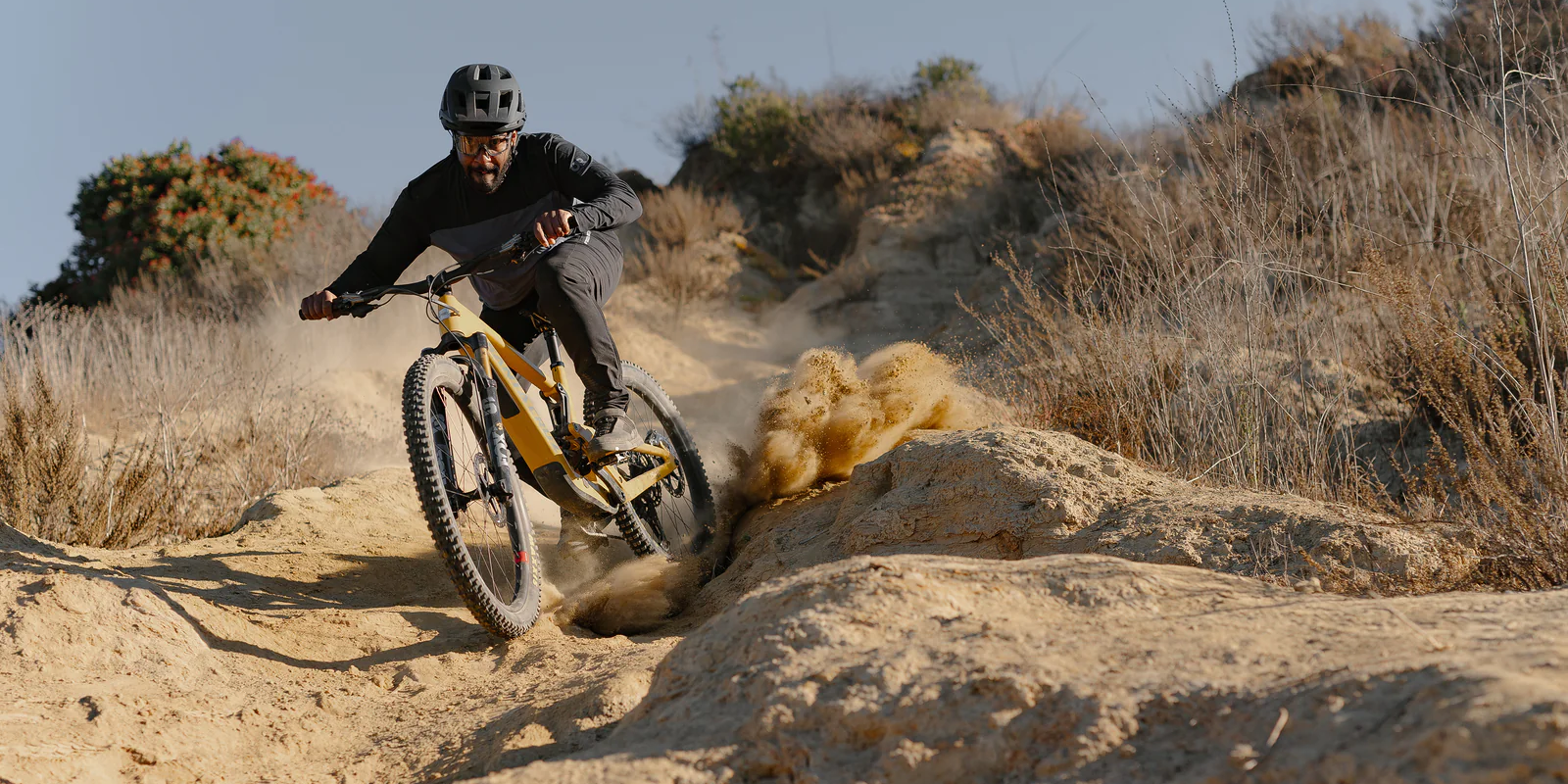
The “Heavy Bike” Paradox: You just spent $8,000 on a high-end E-MTB. It has a Fox Factory 38 fork and a Float X2 shock. Yet, halfway down a technical descent, it feels harsh, dives in corners, and bottoms out on drops that your old 30lb trail bike handled easily. The bike isn’t broken—your setup is.
Physics does not lie. Adding a 15lb motor and battery to a mountain bike fundamentally changes how the suspension interacts with the trail. That extra mass carries significantly more momentum into rock gardens and berms. If you are running standard “analog” pressures and rebound settings, you are riding a compromised machine.
This guide is the definitive resource for tuning Class 1 and Full Power E-MTBs. We will move beyond basic “sag” and dive into volume spacers, high-speed compression, and why “E-Tuned” isn’t just a marketing gimmick.
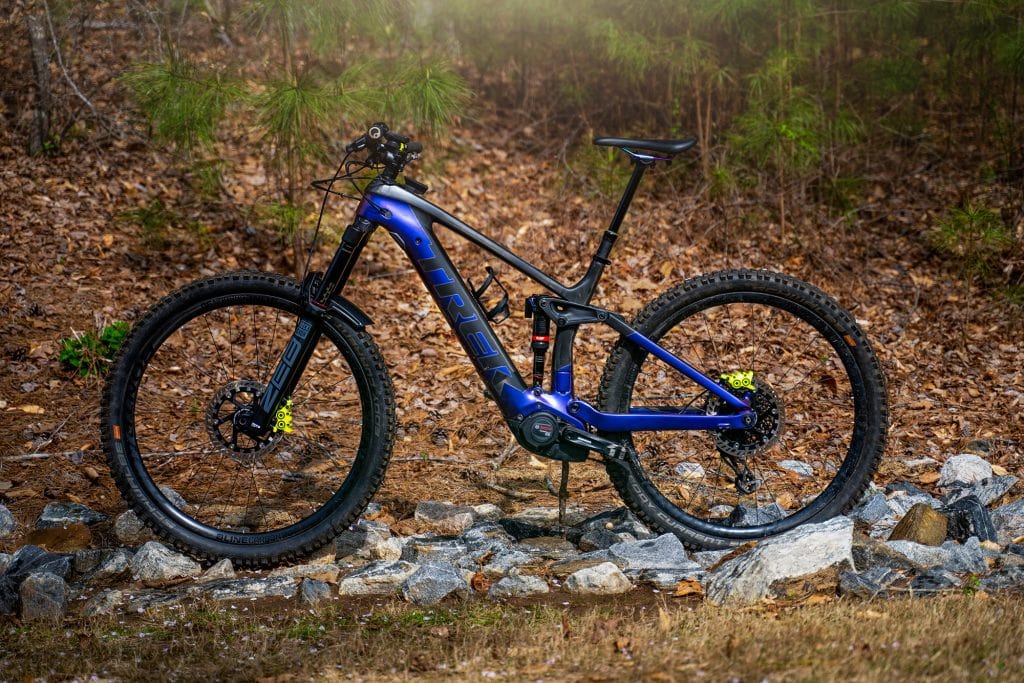
The Physics: Why E-Bikes Feel “Harsh” Yet “Wallowy”
It seems contradictory: How can a fork feel harsh on small bumps but still bottom out easily on big hits? The answer lies in the Sprung Mass ratio.
On a traditional bike, you (the rider) are the vast majority of the weight. On a 55lb E-MTB, the bike itself becomes a larger percentage of the total mass. When you hit a braking bump, that heavy frame wants to keep moving forward. If your suspension is too soft, the bike dives deep into its travel instantly (wallowing). To compensate, riders often add too much air pressure, which kills small-bump sensitivity (harshness).
The Solution? You need a specific “E-Tune” triangle:
1. Higher Air Pressure (Support)
2. More Volume Spacers (Progression)
3. Increased Rebound Damping (Control)
Step 1: The Tools You Actually Need
You cannot tune a high-performance E-MTB with a cheap mini-pump. E-bike shocks often require pressures exceeding 250-300 PSI, which is the redline for standard pumps.
Essential: Fox Digital High-Pressure Shock Pump
Analog gauges are notoriously inaccurate at high pressures (a needle width can be 10 PSI). For E-MTBs, precise repeatability is key. This pump handles up to 350 PSI and lets you bleed air in micro-adjustments.Check Price on Amazon
The DIY Upgrade: Fox/RockShox Volume Spacers
This is the cheapest yet most transformative upgrade you can buy. Plastic “tokens” that snap inside your fork or shock to increase ramp-up. You will need these.Find Spacers for Fox
Step 2: The “E-Tune” Baseline Settings
Forget the chart on your fork leg. Those are written for 30lb bikes. Below is a corrected baseline for a typical full-power E-MTB setup (e.g., Specialized Levo, Trek Rail, or Santa Cruz Heckler).
Case Study Scenario
- Rider Weight: 200 lbs (Geared up)
- Bike Weight: 52 lbs
- Suspension: 160mm Travel (Fox 38 / RockShox Zeb)
| Setting | Standard MTB Target | E-MTB Target (Adjusted) |
|---|---|---|
| Sag | 25-30% | 20-25% (Firmer) |
| Air Pressure | ~90 PSI | ~105-110 PSI |
| Rebound (LSR) | Fast (to pop off jumps) | Slower (+2-3 clicks closed) |
| Compression (LSC) | Open / Plush | Firm (+4-5 clicks closed) |
| Volume Spacers | 1-2 Tokens | 3-4 Tokens |
Technical Insight: Why slower rebound? Because you are running higher air pressure (110 PSI vs 90 PSI), the spring force pushing the fork back up is much stronger. You need more hydraulic damping (slower rebound knob setting) to counteract that extra air force, otherwise, the front wheel will pogo-stick off the ground.
Step 3: Volume Spacers (The Secret Sauce)
This is where the magic happens. Because E-bikes are heavy, they naturally want to blow through their travel on G-outs and berms. If you simply add air pressure to stop this, the bike feels like a jackhammer on small roots.
The Fix: Lower your air pressure slightly (for small bump comfort) but add 1-2 extra volume spacers compared to a standard bike.
How it works: Spacers reduce the air volume inside the fork. This makes the air spring curve “progressive.”
First 30% of travel: Soft and plush (thanks to lower pressure).
Last 30% of travel: Extremely stiff (thanks to the spacer).
This prevents the 50lb bike from slamming bottom on drops.
How to Install Spacers (DIY Level: Easy)
- Depressurize: Release ALL air from the fork/shock.
- Open: Use a chamferless socket (to avoid stripping the nut) to open the air cap.
- Snap In: Clip the plastic spacers onto the cap (Fox) or screw them in (RockShox).
- Inflate: Pump back up. You will likely need 5-10 PSI less than before to achieve the same sag.
Tool Recommendation: Chamferless Socket Set
Standard sockets have a beveled edge that will strip the shallow aluminum nuts on suspension forks. A “chamferless” socket is flat-faced for 100% contact. Do not ruin a $1,200 fork with a $5 socket.Check Price on Amazon
Step 4: Compression Damping (LSC vs. HSC)
E-bikes suffer from “brake dive.” When you grab the brakes on a 55lb bike, that mass pitches forward violently. To stop this without ruining the ride, you need Low-Speed Compression (LSC).
- LSC (Low Speed): Controls rider movements (pedaling, braking, berms).
E-MTB Setting: Run this firmer (closer to “Closed”) to keep the bike riding high in its travel. - HSC (High Speed): Controls square-edge hits (rocks, roots, landings).
E-MTB Setting: Keep this relatively open. Let the volume spacers handle the bottom-out resistance. You want the fork to move fast when you smash a rock.
Advanced: “E-Tuned” vs. Standard Forks
You may see stickers on Fox forks saying “E-Tuned” or “E-Optimized.” Is this marketing fluff?
Actually, no.
E-Tuned (Internals): The damper valving is different. It has a lighter compression tune for the initial stroke (to find traction for the heavy bike) but a much stiffer tune deep in the stroke to manage the weight.
E-Optimized (Chassis): Fox 36/38 E-Optimized forks have thicker stanchion walls. Crucial Note: Because the walls are thicker, the internal air volume is smaller. An E-Optimized Fox 38 actually uses a Fox 34 air piston. This naturally makes the fork more progressive—exactly what an E-bike needs.
Final Checklist for the Perfect E-MTB Ride
1. Sag: Set to 20-25% (Standing, geared up).
2. Spacers: Add 1 more token than you think you need.
3. Rebound: Slow it down until the front wheel stays glued to the ground after a curb drop.
4. LSC: Crank it up to prevent brake dive.