Some links below are affiliate links. If you buy through them, Bike198 may earn a commission at no extra cost to you. Here is how that works.
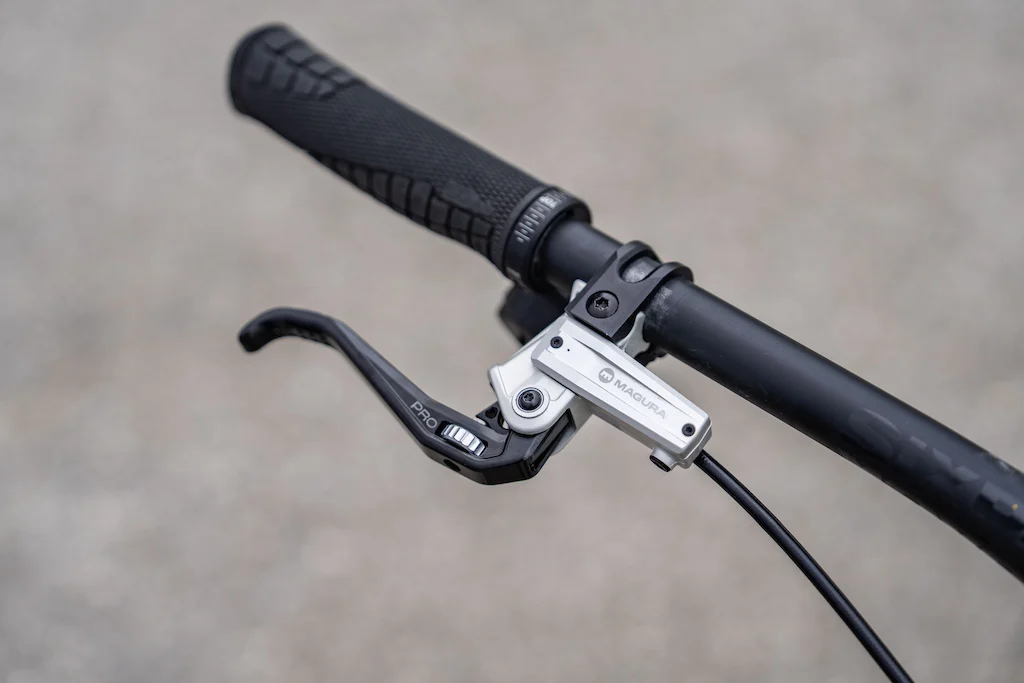
You’re staring at an $800 brake set and wondering if Magura just reinvented stopping power — or if you’re about to pay premium money for aluminum cosmetics on an MT7 reboot. Fair question. Magura’s new Race Pro is the clearest high-end brake launch they’ve made in years: forged-and-CNC aluminum instead of Carbotecture, bigger pistons, Easy Link hose connectors, a claimed 310 g per brake, and a positioning pitch that covers trail through downhill and e-MTB. Specialist shops can already pre-order; first deliveries are expected mid-Q4 2026. [1]
This isn’t a pretend long-term ride review. It’s a buyer’s guide from Magura’s published specs, early independent testing (including a six-week e-MTB test in the Black Forest), and a comparison against the brakes BIKE198 readers actually cross-shop: SRAM Code, SRAM Maven, Shimano XT, and Hope. The question is simple — do Race Pros solve a real problem on your bike, or will pads, rotors, and a proper bleed get you most of the way there for less money?
What Magura Actually Changed
The MT7 has been Magura’s gravity/e-MTB calling card for years — and it polarized people. Plenty loved the power; others never clicked with the lever feel or Carbotecture story. Magura isn’t pitching Race Pro as a mild refresh. They’re calling it the most powerful and precise brake they’ve ever made, and the hardware backs a real shift. [2]
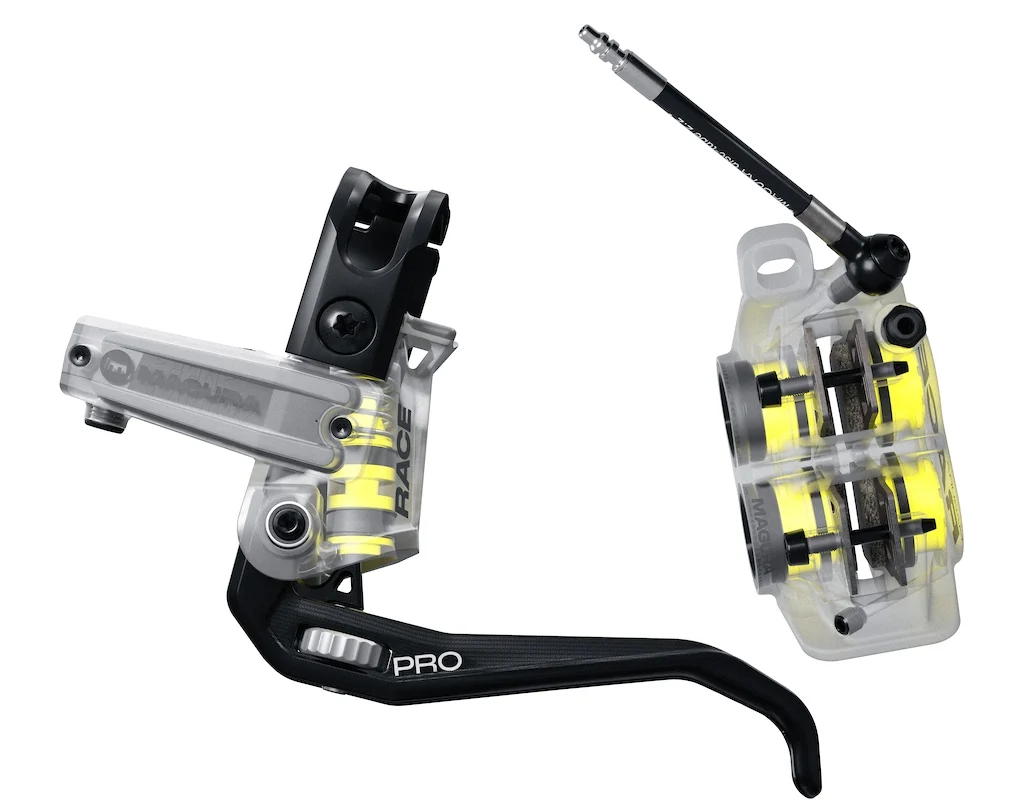
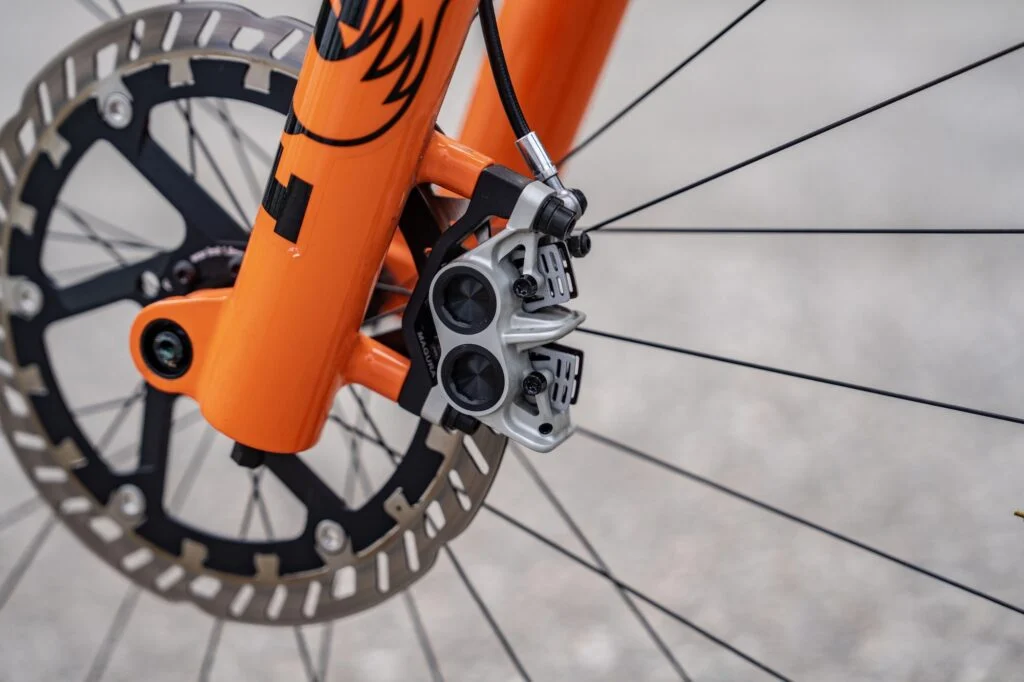
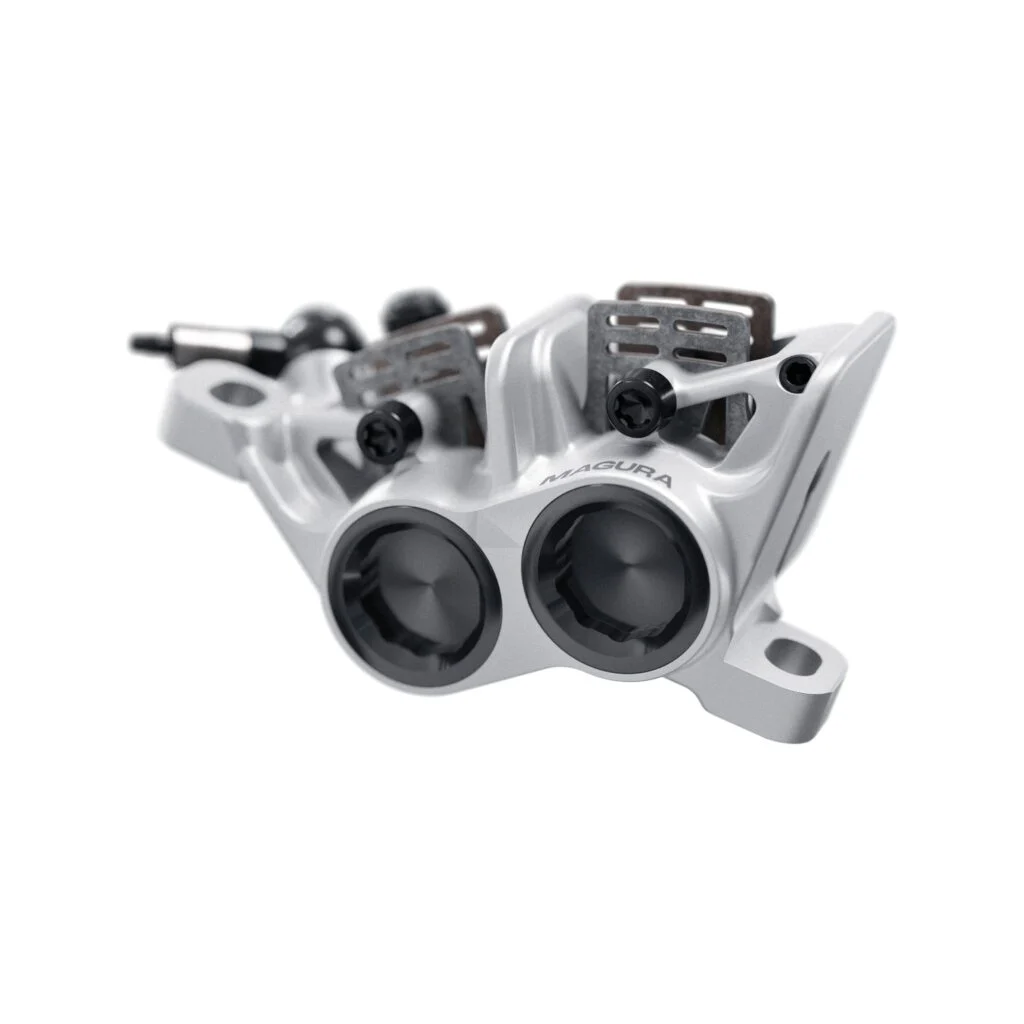
The lever assembly and one-piece four-piston caliper are forged aluminum, then CNC-machined. Matt silver with black accents replaces the older composite look. Magura’s pitch isn’t cosmetics alone: aluminum should feel more premium and survive crashes better than Carbotecture ever convinced skeptics it would. The one-piece caliper (no bolted halves) removes a potential leak path and helps stiffness. [1][2]
Hydraulically, Magura kept its radial master cylinder (the lever acts nearly directly on the master piston) instead of adding rival-style linkages. What changed are the piston sizes: master piston from 10 mm to 12 mm, all four caliper pistons from 17 mm to 19 mm. Bigger pistons alone don’t equal more power — ratio, leverage, stiffness, and friction matter — so Magura pairs the resize with low-friction anodized bores and a ball-bearing lever pivot meant to keep the pull light and free of play. That bearing is a replaceable service part if you keep brakes for years, not seasons. [2]
Stock pads are silver organic. Yellow organic pads are the optional “more bite” compound (claimed ~10% more power) and were used on the early e-MTB test bike. Rotors are 2.0 mm thick (1.8 mm wear limit) in Magura-rated 180–220 mm sizes. Gustav Pro still uses thicker 2.5 mm rotors for maximum heat capacity; Race Pro is pitched as high performance with less weight — Magura claims better thermal behavior than the old MT7 while saving more than 110 g per brake versus Gustav Pro. [2]
Easy Link replaces a conventional threaded hose fitting: fit a connector to the hose, click it into the valve until it seats, and disconnect without opening the master-cylinder side. On bikes with frame- or headset-routed hoses, that’s a real quality-of-life upgrade for headset service and hose shortening. Magura still uses mineral oil, with a more direct oil path that should make bleeds cleaner if it works as advertised in the wild. [2][3]
Other ownership details that matter before you spend the money:
- Claimed weight: 310 g per brake with a 100 cm / 1 m hose [1]
- Reach adjustment: tool-free, indexed (testers counted 83 clicks) [2]
- No free-stroke / bite-point adjustment [2]
- Shiftmix-IG interface in the clamp for mounting shifters or dropper remotes [2]
- Five-year leak-proof warranty; master piston, seals, reservoir cap, and lever bearing available as service parts [1][2]
- Color: matt silver at launch [1]
- RRP: about $805 per set (Magura’s published price is €699.80; no separate US MSRP yet); pre-order via Magura’s trade channel (MBPS), deliveries expected mid-Q4 2026 [1]
What Early Testing Is Actually Saying
The strongest early trail report so far is from E-MOUNTAINBIKE / ENDURO Mountainbike Magazine’s Benedikt Schmidt, who ran Race Pros on a Propain Sresh SL e-MTB for about six weeks in the Black Forest on Yellow pads — more mass, speed, and heat than a light trail bike. [2]
 From the Bike198 shopIs My Bike Ok?$26Shop
 Headline impressions: very low finger effort for the power on tap; a clear bite, then linear power build; real reserve when you lean on them; no notable fade or bite wander on long steep descents in that window; and no pad rattle of the sort older Magura setups have been dinged for.
The big knock is also consistent: at about $800, no bite-point adjustment is a real miss. Reach adjust is excellent. Free stroke is missing. If you dial bite point on Shimano or SRAM religiously, that will bug you. [2]
Take the praise seriously and keep the sample size honest. One strong six-week e-MTB test beats a press release. It is not a full season of mud, freeze-thaw, and multiple pad/rotor setups. Treat it as a green light to shortlist Race Pro — not as proof it wins every argument forever.
Race Pro vs Code, Maven, XT, and Hope
This is the comparison most of you will actually make. Approximate street pricing and weights move by region and model year, so use the bands below as orientation, not a shop quote. The point is character and use case.
SRAM Code
Still the default “good enough gravity brake”: four pistons, familiar SRAM feel, solid trail/enduro coverage, usually cheaper than halo stoppers. Complete front ends often land around the low-300 g range depending on trim. Power is real, but it’s no longer SRAM’s ceiling. If your Codes are healthy and you’re not cooking them on long alpine runs or a heavy e-bike, Race Pro is a want more often than a need. [4][5]
SRAM Maven
This is the brake Magura has to beat on raw shut-down reputation: four pistons, mineral oil on current Mavens, progressive SRAM character, bite-point and reach adjust on typical trims, and a large claimed jump over Code. Trade-offs are weight (complete ends often mid-360 g) and price that climbs fast on top trims. Want maximum on-demand power and SRAM’s ramp? Maven remains the obvious cross-shop. Race Pro counters with claimed ~310 g (1 m hose), linear Magura feel, Easy Link, and early e-MTB fade notes. [4][5][6]
Shimano XT (current 4-piston trail/AM)
Still the pragmatic pick: mineral oil, tool-free reach, free-stroke adjust, parts everywhere, and pricing that looks sane next to $800 Maguras. Complete front weights often sit near or under 300 g. Some riders still find XT firmer and more “on/off” than Magura’s long linear pull. If you already like XT and your rotors/pads are fresh, Magura has to win on feel and Easy Link — not spreadsheet necessity. [4][5][7]
Hope (Tech 4 V4 / current high-power Hope)
Hope’s lane is power, modulation, rebuildability, and buy-once ownership. Tech 4 V4 shows up in group tests as a high-power, controllable option with tool-free reach and bite-point adjust, DOT fluid, and premium pricing. It’s often heavier than Magura’s Race Pro claim, and DOT is a workshop manners issue some riders refuse. If every spare part and long-term rebuildability matter most, Hope stays elite. Race Pro answers with mineral oil, Easy Link, Magura ergonomics, and a lighter claimed weight. [5][8][9]
Quick-reference comparison
| Brake | Fluid | Standout trait | Bite-point adjust | Typical shopper | Rough price posture |
|---|---|---|---|---|---|
| Magura Race Pro | Mineral oil | Linear power, light lever effort, Easy Link | No | Trail to DH / e-MTB wanting Magura feel + serviceability | Premium (~$805 / €699.80 RRP per set) |
| SRAM Code | DOT (classic Code lineage) | Proven all-rounder | Usually yes (trim-dependent) | Trail/enduro value | Mid to upper-mid |
| SRAM Maven | Mineral oil (current) | Maximum power + tunability | Yes | Enduro / DH / e-MTB power seekers | Premium |
| Shimano XT 4-piston | Mineral oil | Value, availability, free stroke | Yes (free stroke) | Trail / AM pragmatists | Mid |
| Hope Tech 4 V4 / high-power Hope | DOT | Power + rebuildability | Yes | Long-term owners, gravity | Premium |
Should You Upgrade — Or Just Bleed What You Have?
Before you drop Magura money, run this boring checklist. It saves people constantly.
- How old are the pads and rotors? Glazed organic pads and thin, heat-spotted rotors fake “weak brakes” every day of the week.
- When was the last clean bleed? Spongy levers and wandering bite are often air and contaminated fluid, not a reason for an $800 set.
- Are you on undersized rotors for the bike? A heavy e-MTB or long alpine descents on 180s will humble almost any caliper. Stepping to Magura-compatible 200–220 mm rotors (where the frame/fork allow) is often the smarter first move.
- Is the problem power, or lever feel? If you have enough power but hate the lever character, a different brake brand can be rational. If you don’t have enough power, fix heat capacity and friction surface first.
- Do you wrench internally routed bikes a lot? Easy Link is a real feature if you service headsets and cockpits yourself. If you never disconnect a hose, it’s a smaller selling point.
Buy Race Pros if you want Magura’s linear, low-effort character; you need serious trail-to-gravity / e-MTB power; you value mineral oil plus a sealed hose disconnect; and you’re okay paying a premium without bite-point adjust. Stay put (or buy XT/Code money) if your current brakes are under-maintained, your rotors are the weak link, or you refuse to give up free-stroke dialing.
Frequently Asked Questions
Are Magura Race Pro brakes better than the MT7?
On paper and in early testing, they look like a real step forward: aluminum construction, larger pistons, stronger claimed thermal behavior than the MT7, and Easy Link servicing. Magura is not marketing this as a cosmetic MT7. Early trail notes back a power and control bump while keeping Magura’s linear feel. [2]
When will Race Pros be available?
Retailers can pre-order now through Magura’s trade channel. First deliveries are expected in mid-Q4 2026. [1]
Do Race Pros work for e-MTBs?
Magura lists e-MTB among intended uses, and the strongest early test so far was on a heavy e-MTB without notable fade in a six-week window. That doesn’t make them magic — rotor size and pads still matter — but they’re clearly aimed at e-bike heat loads, not just XC vanity builds. [1][2]
What rotors do they need?
Magura specifies 2.0 mm rotors with a 1.8 mm wear limit, in suitable Magura rotors from 180 to 220 mm. Don’t cheap out here; mismatched rotor thickness and worn hardware will sabotage any premium caliper. [2]
Why is there no bite-point adjustment?
That’s the main criticism at this price. You get excellent tool-free reach adjust and Magura’s radial lever character. You do not get free-stroke / bite-point dialing. If that adjuster is non-negotiable, cross-shop XT, Maven, or Hope before you commit. [2]
Is about $805 realistic versus rivals?
It’s premium — Magura’s published RRP is €699.80, roughly $805 at current exchange, with no separate US MSRP listed yet. That lands in high-end Maven/Hope territory and clearly above typical XT and many Code builds. You’re paying for aluminum execution, Magura’s power/modulation pitch, Easy Link, warranty, and service parts — not for being the bargain brake of 2026. [1][4][5]
Which One Should You Buy?
If you love Magura’s even, fingertip-friendly power delivery and you wrench modern internally routed bikes, Race Pro is the most compelling Magura brake in a long time — with the asterisk that bite-point adjust is missing at a halo price. If you want maximum SRAM-style shut-down and tunability, Maven still owns that lane. If you want the smart everyday upgrade that shops can service anywhere, XT (or a refreshed Code setup with honest rotors) will keep making more financial sense for a lot of trail riders.
The Race Pro doesn’t have to be the brake everyone buys. It has to be the brake that makes sense when Magura’s feel is the thing you’ve been chasing. On the current evidence, that group of riders finally has a modern aluminum answer that looks ready for trail, enduro, DH, and e-MTB duty when stock arrives mid-Q4.
Check live pricing and rotor compatibility before you order, and don’t skip pad bed-in. Brakes don’t become “Race Pro good” until the friction surfaces are ready.
Sources
- BikeBiz — Magura Race Pro launch specs, price, warranty, availability: https://bikebiz.com/magura-unveils-new-race-pro-disc-brake/
- E-MOUNTAINBIKE Magazine — Race Pro detail and six-week e-MTB trail test: https://ebike-mtb.com/en/magura-race-pro-brake-review/
- Magura — Easy Link hose connector overview: https://magura.com/how-to-create-easy-link/
- Dunbar Cycles — Maven vs Code vs XT comparison context: https://dunbarcycles.com/blogs/default-blog/sram-maven-vs-code-vs-shimano-xt-the-ultimate-brake-shootout
- BikeRadar — Best mountain bike disc brakes 2026 (Maven, Hope entries): https://www.bikeradar.com/advice/buyers-guides/best-mountain-bike-disc-brakes
- BikeRadar — SRAM Maven coverage in buyers’ guide / reviews listed above
- Flow Mountain Bike — Living with XT, Maven, Hope: https://flowmountainbike.com/tests/living-with-sram-maven-hope-gr4-shimano-xt-m8220-brakes/
- ENDURO Mountainbike Magazine — Hope Tech 4 V4 comparison-test context: https://enduro-mtb.com/en/hope-tech-4-v4-mtb-brakes-comparison-2024/
- Dunbar Cycles — Hope vs Shimano vs SRAM ownership framing: https://dunbarcycles.com/blogs/default-blog/hope-vs-shimano-vs-sram-brakes-which-mtb-brake-brand-is-worth-it-in-canada
Independently verified against Magura launch materials and published third-party tests. Not a personal long-term BIKE198 ride review. Specs, pricing, and availability can change before mid-Q4 deliveries.

I founded Bike198 back in 2008 and started riding bikes seriously in 1994. A lot has changed since that time and one of the greatest releases is still getting out on the bike and shredding trail or tearing up the road.