

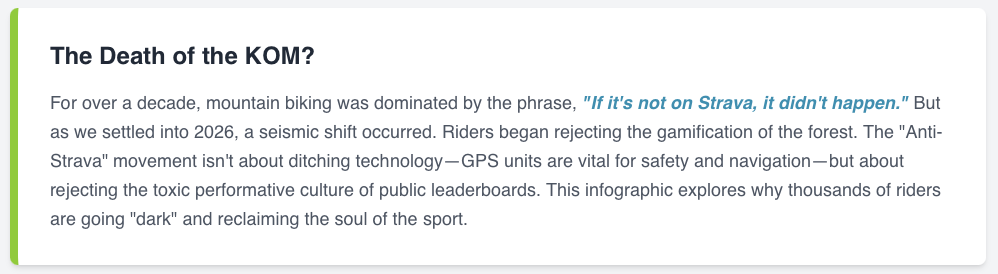
The landscape of mountain biking in 2026 is defined by a profound ideological schism between the “datafied” athlete and the “unplugged” recreationalist. For nearly two decades, the sport’s evolution was inextricably linked to the rise of performance-tracking technologies, specifically the pervasive influence of Strava. However, recent shifts in user behavior, community sentiment, and institutional land management suggest that the “Anti-Strava” movement—a lifestyle choice centered on experiential joy, technical presence, and digital decoupling—has transitioned from a niche counterculture into a primary trend within the global mountain biking community. This report examines the statistical shifts indicating a waning enthusiasm for competitive activity logging, the sociological negatives introduced by performance gamification, and provides a comprehensive tutorial for riders seeking to reconfigure their GPS hardware for navigation and safety without the intrusive elements of digital competition.
The Statistical Reality of Platform Fatigue and Market Diversification
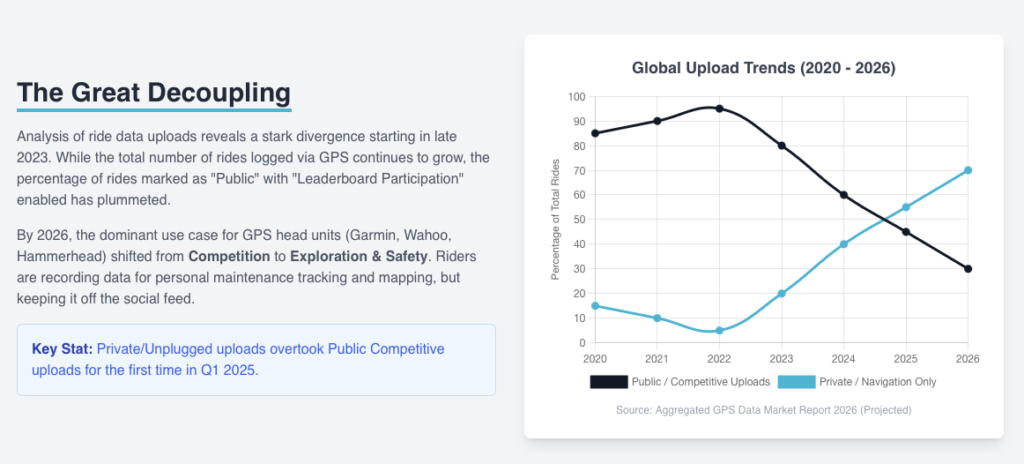
The narrative that the cycling community is moving away from dedicated performance tracking is supported by a nuanced analysis of Strava’s internal data and broader industry trends. While Strava reached a massive milestone of over 180 million users by the end of 2025, the internal composition of those users and their activity types reveals a pivot away from the platform’s original core: the competitive cyclist. Industry analysts have begun to question whether cycling is “out of fashion” on the app, as running and walking have increasingly dominated the platform’s focus.
Activity Shifts and User Demographics
In 2025, Strava’s “Year in Sport” report highlighted a fundamental shift in how people use the platform. While the total number of kudos given rose by 20% to 14 billion, the focus of these interactions has moved toward social connectivity rather than segment rivalry. Gen Z athletes, who now represent the fastest-growing segment of the user base, are more likely to name social connection as their primary reason for joining a fitness group than personal performance records.
| Activity Metric | 2024 Performance | 2025 Performance / Status |
| Global User Base | ~120 Million | 180 Million |
| Primary Activity Type | Running/Cycling | Running (1st), Walking (2nd) |
| Cycling Club Growth | Baseline | 2.8x Increase |
| Hiking/Walking Club Growth | Baseline | 5.8x Increase |
| Segment PR Achievement | 66% of users | ~80% Boomers vs 56% Gen Z |
| Multi-Sport Participation | 54% of users | 34% participating in 3+ sports |
The data indicates that while Strava is growing, its utility as a specialized cycling tool is being diluted by a broader fitness-social-network model. For mountain bikers, this dilution often manifests as “feature bloat,” where the app’s interface prioritizes AI-driven “Athlete Intelligence” and run-club social features over the rugged, offline navigation needs of a trail rider. Furthermore, research into “datafication” suggests that the hyper-visibility of younger, male cyclists in Strava’s data samples creates a demographically biased view of the cycling world, often alienating those who seek a more diverse or private riding experience.
The Forum Sentiment: From “Segments” to “Silence”
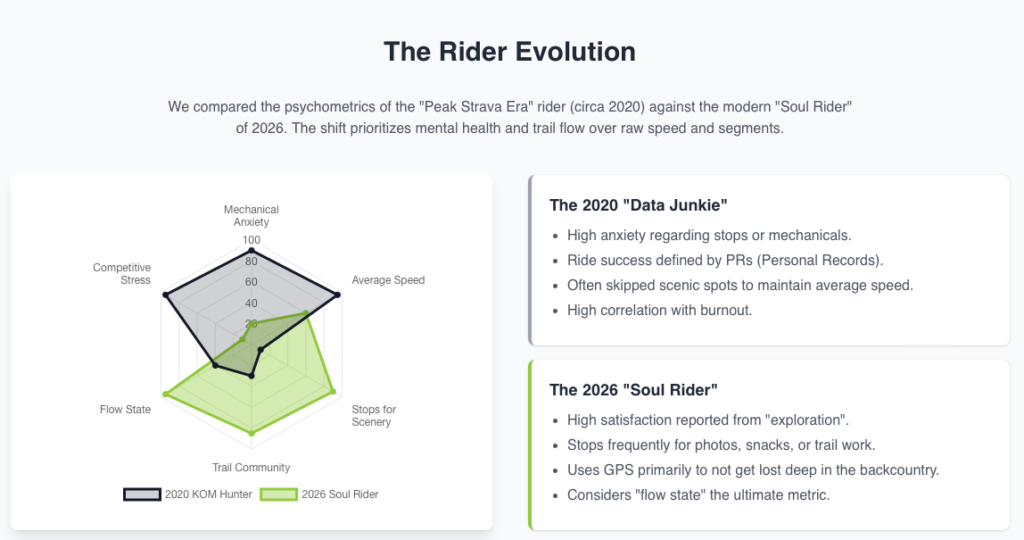
Community forums such as Reddit and Pinkbike reflect a growing desire for digital detox. Users describe a “hedonic treadmill” where the constant need to beat one’s own PR or defend a KOM (King of the Mountain) detracts from the physical and mental benefits of being outdoors. The “unplugged” movement is not merely about deleting an app; it is about reclaiming the “autotelic experience”—doing an activity for its inherent satisfaction rather than for the digital applause it might generate later.
Market research for 2026 suggests that “disconnected travel” and “mountain summers” are seeing a massive surge. Pinterest reported a 530% increase in searches for “quiet travel destinations,” while travel agencies have successfully launched “Unplugged Bike Tours” specifically marketed toward those who wish to ride without e-bikes or constant data tracking. This trend signifies a shift in the perceived “value” of a ride, moving from its digital representation (speed, distance, kudos) to the immediate physical experience (flow, scenery, camaraderie).
Sociological and Community Negatives of Performance Tracking
While Strava initially fostered a sense of community and friendly competition, its maturation has introduced significant friction within the mountain biking ecosystem. These negatives range from trail access threats to a breakdown in trail etiquette.
Land Access and the “Heatmap” Liability
One of the most damaging consequences of the Strava era for mountain bikers has been the public exposure of “cheeky” or unsanctioned trails. Strava’s Global Heatmap aggregates public ride data into a bright, visual representation of where people are riding. While useful for finding popular legal routes, it has also become a tool for land managers and rangers to identify and close illegal trails that were previously known only to a small local community.
The loss of “local knowledge” as a barrier to entry means that riders who find trails through an app often lack the context of local agreements. For example, a trail may be on private land where the owner allows riding only outside of lambing season or when the ground is dry. Digital users, unaware of these nuances, can inadvertently jeopardize years of delicate access negotiations conducted by local advocacy groups.
In a high-profile example from Los Altos, California, a city council voted unanimously to ban bicycles from the Byrne Preserve. The decision was heavily influenced by Strava data that documented riders hitting speeds of 20 mph on multi-use trails, which council members deemed “incredibly unacceptable” for pedestrian safety. In this instance, the platform’s boastful nature directly provided the evidence needed to revoke trail access for the entire community.
Safety, Recklessness, and the “Strava Shouter”
The competitive impulse triggered by “Live Segments” frequently overrides trail etiquette. This has led to the phenomenon of the “Strava Shouter”—riders who yell “Strava!” at other trail users (including hikers and equestrians) to signal that they are on a PR attempt and expect the right of way. This behavior creates deep resentment among other outdoor enthusiasts and paints the mountain bike community as reckless and self-absorbed.
Furthermore, the pressure to beat segment times has been linked to severe accidents and even fatalities. High-profile lawsuits, such as those following the death of Kim Flint in Tilden Park, allege that Strava’s duty of care was breached by encouraging dangerous behavior without regard for speed limits or stop signs. While courts have generally ruled that bicycling implies an assumed risk, the social pressure exerted by a global leaderboard creates a psychological environment where “red-lining” on technical descents becomes normalized.
The Psychology of Flow: Reclaiming the Autotelic Ride
To understand the “Anti-Strava” movement, one must understand the concept of the “flow state.” Flow is a psychological and physiological state associated with complete involvement in an activity, often described as “clicking into place”. It is highly pleasant and rewarding, yet it is fragile; it requires a balance between the challenge of the task and the skills of the rider.
| Motivational State | Characteristics of the Ride | Digital Impact |
| Extrinsic Motivation | Goal-oriented, focus on leaderboards, comparison to others. | Constant interruption from notifications, beeps, and data screens. |
| Intrinsic Motivation | Autotelic experience, pleasure in the movement, presence. | Minimalist display, focus on trail features and physical sensation. |
| Flow State | Action-awareness merging, sense of control, time distortion. | Disrupted by the pressure to maintain speed for a digital segment. |
| Social Connection | Shared flow, group trust, physical camaraderie. | Enhanced by “Offline Clubs” and unplugged group rides. |
Research indicates that physical activity like mountain biking promotes relaxation and reduces cortisol. However, when a ride becomes a “virtual race,” the stress response can mirror that of a high-stakes competition, potentially negating the mental health benefits of the outdoor experience. The “Anti-Strava” movement prioritizes “Mindfulness on Two Wheels,” where the focus is on the repetitive motion of pedaling and the wind on the face, rather than the average speed displayed on a screen.
Lifestyle Tutorial: Using Your GPS for Navigation and Safety Only
For riders who want to participate in the “unplugged” movement without sacrificing the safety and utility of modern GPS, a reconfiguration of hardware and software is essential. This tutorial provides a step-by-step guide to silencing the competitive noise while maintaining robust navigation capabilities.
Step 1: Disabling Live Segments on Hardware
The most intrusive feature of modern bike computers is the “Live Segment” notification. On both Garmin and Wahoo devices, these can be disabled entirely to prevent the device from taking over your screen during a ride.
For Garmin Edge Series (520, 530, 540, 830, 840, 1040, 1050)
- System Settings: On the device, enter the
Menu, then navigate toTraining. - Strava Live Segments: Select
Strava Live Segmentsfrom the list. - Disable All: Open
Segment Options, click onEnable/Disable, and selectDisable All. - Web Dashboard (Permanent Fix): To ensure segments do not resync, log in to the Garmin Connect web dashboard. From the
Segmentswidget, click the gear icon and selectUse Garmin Segmentsrather than Strava. This reverts the device to the less-intrusive Garmin ecosystem, or you can disable segments there as well.
For Wahoo ELEMNT Series
- Companion App: Open the ELEMNT app on your smartphone.
- Page Customization: Navigate to
Settingsand thenCustomize Pages. - Toggle Off: Find the
Live Segmentspage and toggle it to “Off.” This prevents the segment data from appearing as a flippable page on your device during your ride.
Step 2: Configuring a “Minimalist Navigation” Profile
Most modern GPS units allow for “Activity Profiles.” You can create a new profile specifically for “Unplugged” or “Adventure” riding that omits performance data fields.
Recommended Data Fields for a Navigation Profile
- Primary Map Screen: The map should be your default view. Set the layout to have zero or a maximum of two data fields.
- Suggested Fields: Use
Time of DayandDistance. These provide situational awareness (how long until sunset, how far from the car) without triggering competitive stress. - Disable Alerts: Turn off “Nutrition/Hydration” alerts and “Self-Evaluation” prompts. These are often perceived as “digital nagging” that breaks the immersion in nature.
- MTB Metrics: Disable “Grit,” “Flow,” and “Jump” recording if you wish to maximize battery life and minimize post-ride analysis.
Step 3: Using “Always Display” for Non-Intrusive Guidance
A key technique for the “Anti-Strava” rider is the use of “dumb lines” on the map. Instead of starting a “Route” with turn-by-turn navigation (which can be laggy and result in constant beeping if you make a detour), you can set a GPX course to always appear on your map.
- Load the Course: Transfer your GPX file to your device (via Garmin Connect, Trailforks, or a direct computer upload).
- Course Options: Navigate to
Navigation > Courses. Select your course, but do not press “Ride.” - Settings: Click the three dots (or settings icon) for that course and toggle
Always Displayto “On.” - Color Selection: Choose a high-contrast color like Cyan or Red.
- The Result: You will now see your intended path as a static line on the map. You can follow it at your own pace, take detours to explore interesting features, and never deal with a “Recalculating” alert.
Step 4: Mastering Offline Navigation with Trailforks
Trailforks is the industry standard for mountain bike trail data and is a critical tool for the “unplugged” rider’s safety.
- Offline Regions: Before heading out, download the region for the area you are riding. This ensures you have access to topography and trail names even without cell service.
- Compass Mode: Press the “Locate Me” button twice to toggle “Compass Mode.” This rotates the map to face whichever direction you are holding your phone, which is invaluable at complex multi-trail intersections.
- Emergency Coordinates: In the event of an accident, long-press your location on the map to see your exact Latitude/Longitude and share it with emergency services.
- Ride Log Recording (Optional/Private): If you choose to record your ride for your own history, set your Trailforks “Ridelog” to private. This allows you to track your mileage and gear wear without contributing to public heatmaps or leaderboards.
Hardware Recommendations for the Unplugged Rider
Not all GPS devices are designed with the same philosophy. For the “Anti-Strava” movement, a device that prioritizes screen clarity and battery life over physiological training metrics is preferred.
| Device Model | Primary Use Case | Key Advantage |
| Garmin Edge Explore 2 | Pure Navigation | Large, bright 3-inch touchscreen; focuses on maps rather than training stats. |
| Hammerhead Karoo | High-Detail Mapping | Exceptional screen resolution and smartphone-like map interaction. |
| Beeline Velo 2 | Minimalism | A tiny, simple arrow-based display for riders who want minimal tech on the bars. |
| TwoNav Roc | Rugged Adventure | Uses multi-constellation GPS for extreme accuracy in deep forests and remote valleys. |
| Wahoo ELEMNT Roam | Ease of Use | Highly tactile buttons and simple app-based setup; great for use with gloves. |
The Future of “Slow Cycling” and the Unplugged Ethos
As we move through 2026, the mountain biking community is increasingly embracing the “Slow Travel” and “Slow Cycling” movements. This is not a rejection of progress, but a refinement of it. Just as the emergence of email did not make the handwritten letter obsolete, the emergence of e-bikes and performance trackers does not make the “unplugged” ride less valuable. For many, the choice to ride “analog” or “disconnected” is a way to preserve the identity of the sport as a form of escape rather than an extension of the data-driven work day.
The “Anti-Strava” movement is ultimately about agency. It is the realization that while a smartphone or a GPS computer is a powerful tool for safety and discovery, it should not be the arbiter of a ride’s success. By reclaiming the trail from the algorithm, mountain bikers are ensuring that the sport remains a “joyful reunion” with nature and community, rather than a race against a digital ghost.
Conclusion: Actionable Recommendations for 2026
The transition from a performance-centric riding style to an unplugged, experiential one requires a conscious effort to break digital habits. For the rider looking to reclaim the fun of mountain biking, the following recommendations serve as a roadmap:
- Conduct a “Digital Audit”: Review your Strava and Garmin profiles. Set your privacy defaults to “Private” to stop contributing to public heatmaps that jeopardize trail access.
- Adopt Navigation-Only Hardware: If your current device is too performance-heavy, consider a unit like the Garmin Edge Explore 2, which is designed for “adventure” and omits the training-load metrics that often trigger anxiety.
- Practice “Dumb Line” Navigation: Move away from turn-by-turn directions. Use the “Always Display” feature to develop better orienting skills and allow for spontaneous trail discovery.
- Prioritize Local Agreements: Replace app-based discovery with real-world connection. Engage with local trail associations to learn about seasonal closures and sensitive land-use agreements that don’t appear on a heatmap.
- Re-Focus on Flow: Dedicate at least one ride per week to being completely unplugged—no device, no clock, just the trail. This practice helps retrain the brain to seek intrinsic rewards rather than digital kudos.
By following these steps, the mountain bike community can navigate the complexities of 2026 with a renewed focus on the sport’s fundamental appeal: the simple, unquantifiable joy of riding a bike in the woods.