
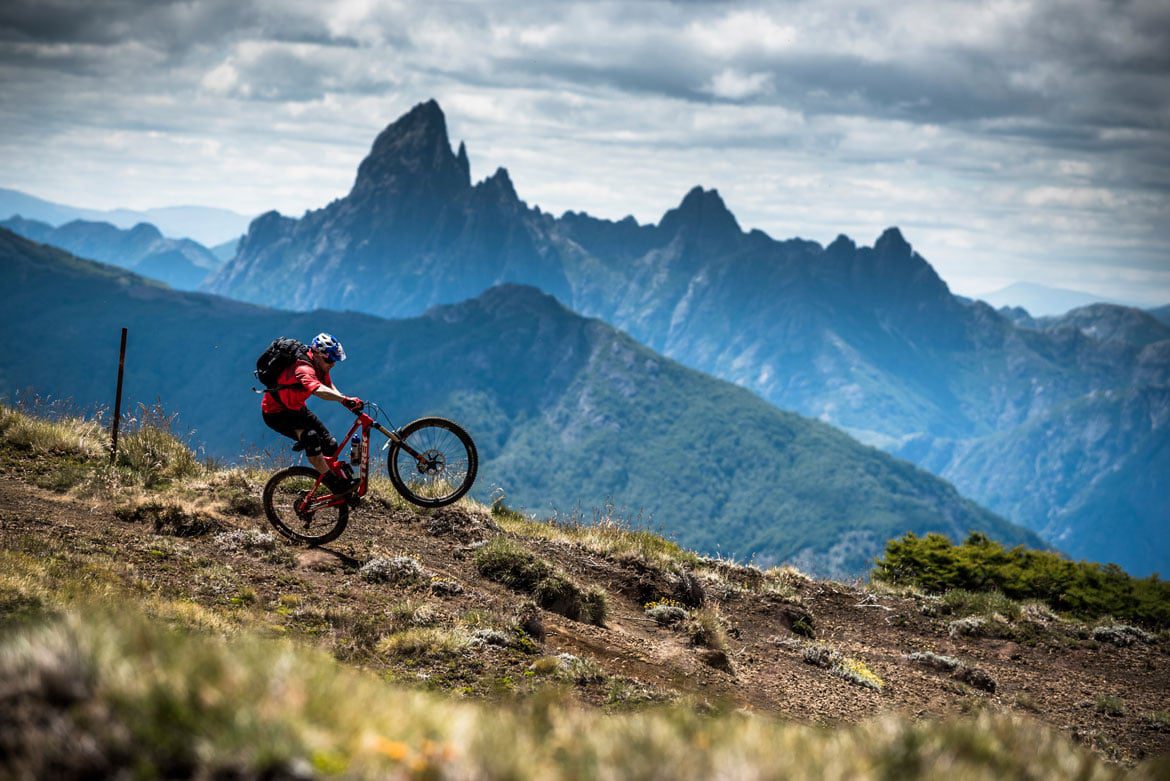
The manual and the wheelie. Two of the most visually satisfying things you can do on a mountain bike — and two of the most misunderstood skills in all of riding. Ask most people and they’ll treat them as the same trick. They’re not. Not even close. These two maneuvers have completely different mechanics, different applications on the trail, and require an entirely different approach to learn.
If you want to go from letting the trail dictate what your bike does to actively controlling how your bike interacts with the terrain, you need both of these skills in your toolkit. Let me break down exactly what separates them, why they matter, how your bike setup affects your ability to do them, and the most efficient way to actually learn each one.
Manuals vs Wheelies – What’s the Actual Difference?
Before we get into the how, let’s make sure we’re clear on what we’re actually talking about.
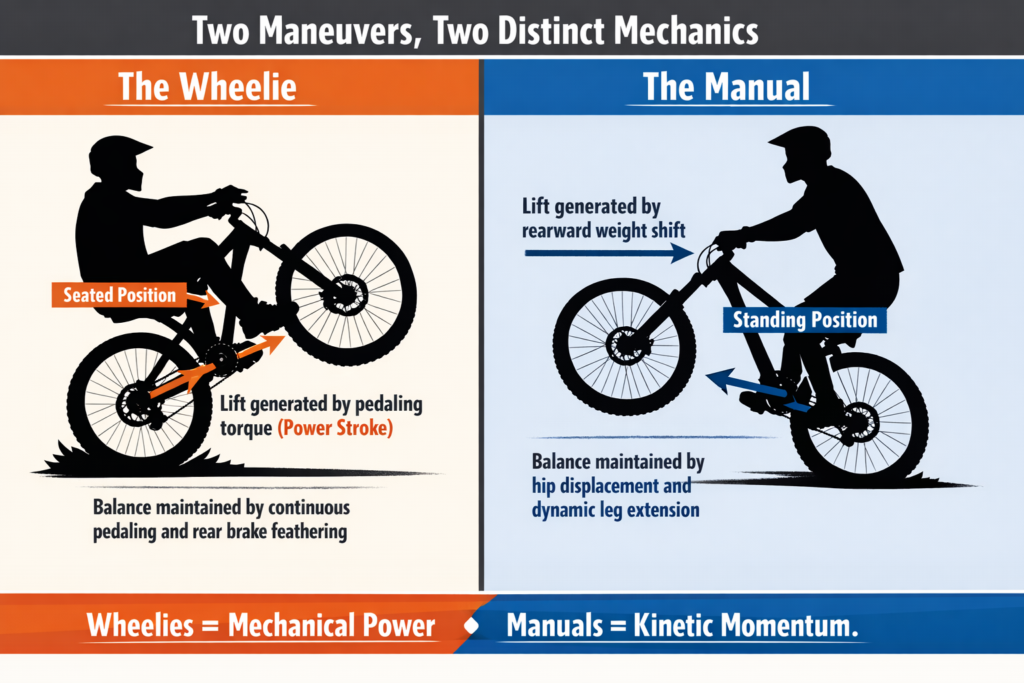
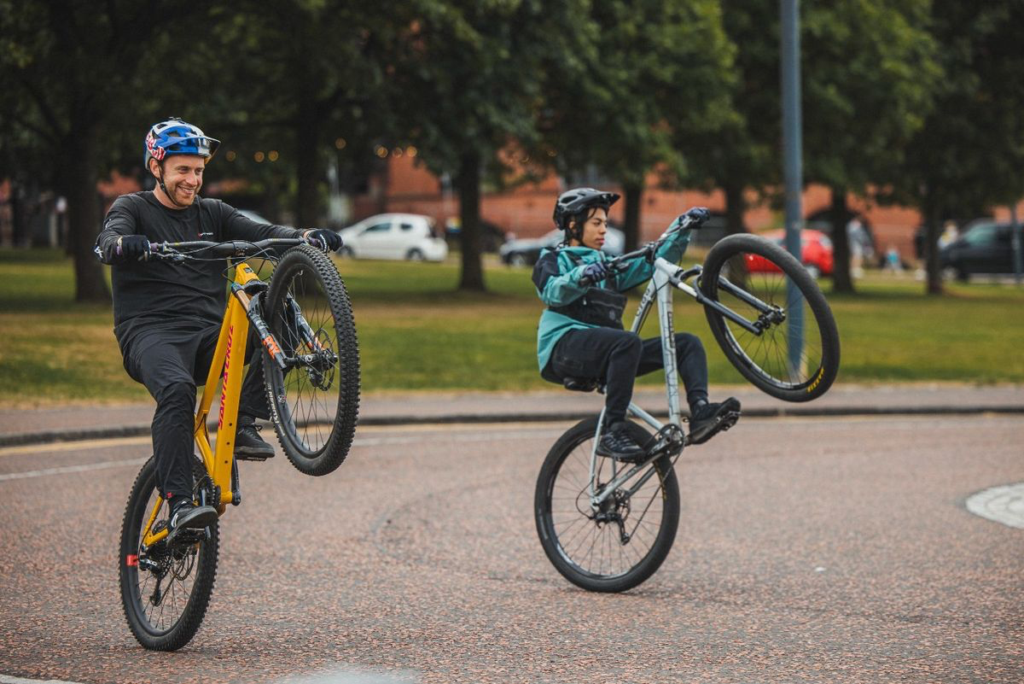
A wheelie is a seated maneuver. You stay planted on the saddle and use pure drivetrain torque — pedaling power — to lift and hold the front wheel. It’s a mechanically assisted skill, which is exactly why it’s easier to learn. The saddle gives you a third point of contact that stabilizes everything.
A manual is a completely different animal. You’re standing on the pedals, there’s zero pedaling involved, and the entire maneuver runs on forward momentum and bodyweight positioning. You’re essentially balancing on the rear axle by shifting your hips back behind it and locking your arms straight. No engine, no crutch — just physics and technique.
| Wheelie | Manual | |
|---|---|---|
| Rider position | Seated | Standing |
| What powers it | Drivetrain torque | Forward momentum |
| Balance control | Rear brake + pedal cadence | Hip position + leg extension |
| Primary use | Climbing, low-speed obstacles | High-speed flow, drops, bump absorption |
The wheelie is your go-to for technical climbing and low-speed trail features. The manual is your high-speed momentum tool — the one that separates riders who flow over the trail from riders who fight it.
Why These Skills Matter on the Trail
This isn’t just about style points. Both of these skills have direct, practical applications every time you ride.
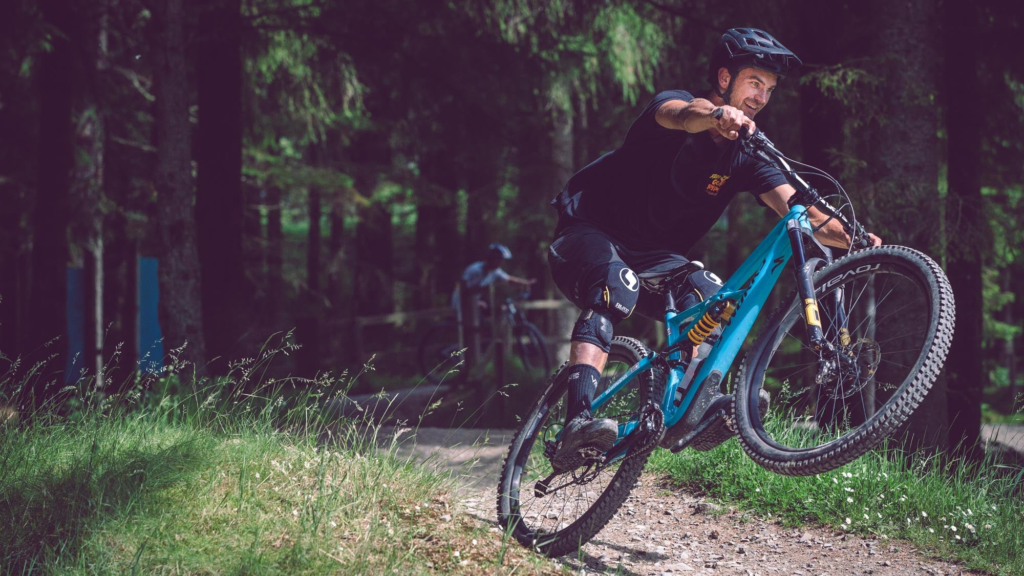
The manual keeps your speed. When you hit a roller or a sequence of trail bumps and let your front wheel track the terrain blindly, the upward slope of that feature acts like a wall. The bike decelerates hard. By lofting the front wheel over the feature and only letting the rear wheel track the terrain, you completely eliminate that drag. When done right through a set of rollers, you can actually come out faster than you went in.
The manual protects you on drops. Hitting a drop with both wheels at the same time — especially at low-to-medium speed — pitches the nose of the bike forward aggressively when the front wheel lands first. That’s a recipe for going over the bars. A sharp manual off the lip keeps the bike level through the air and sets you up for a rear-wheel-first or simultaneous landing every time.
The manual is the first half of a proper bunny hop. If you’re doing a bunny hop by pulling up with clipless pedals, you’re doing it wrong and you’re limiting your height. A real bunny hop starts with a manual to load the front end, then a spring off the rear. No manual foundation, no real bunny hop.
The wheelie is your low-speed secret weapon. On technical climbs where momentum is scarce, being able to loft the front wheel over a root or a step keeps the bike moving forward instead of stalling. It also builds brake modulation skills that pay dividends in every other aspect of your riding.
Set Your Bike Up for Success
Before you ever try to manual or wheelie, your setup can either work with you or against you. A few things that have a big impact:
Chainstay length changes everything. The chainstay is the distance from your bottom bracket to your rear axle. Short chainstays — like you’ll find on a dirt jump or a shorter playful trail bike — make it much easier to get the front end up. Long chainstays on an enduro or DH rig are designed for stability, which means they actively resist what you’re trying to do. You’ll need a more explosive weight shift to overcome that geometry.
Your stem and bar height matter. If your stem is longer than about 60mm, your weight sits too far forward over the front axle. Getting it back far enough for a manual becomes a fight. Low bars have the same problem — they force you to hinge too far at the hips. If your cockpit feels like it’s fighting you during these skills, it might not just be your technique.
Lock out your rear shock. This is one people skip, and it kills their practice sessions. A plush rear shock absorbs the energy you’re trying to use to lift the front wheel. It also bobs up and down while you’re trying to hold the balance point, which constantly changes the geometry beneath you. Flip on your lockout or crank up your low-speed compression damping before you practice. It turns your full suspension into a predictable hardtail platform and makes a dramatic difference.
How to Learn the Wheelie
The wheelie has a reputation for being the “easier” of the two — and that’s accurate. The saddle lowers your center of gravity and gives you a stable base. Still, it’s a skill, and if you try to brute-force it without setting things up correctly, you’ll spin your wheels for months.
Step 1: Gear Selection and Saddle Height
Drop your saddle two to three inches lower than your normal pedaling height. You need your center of gravity lower and you need some extra range in your legs to generate torque when the front end is in the air.
For gears, pick a medium-easy cog — second or third from the biggest on your cassette. Avoid the granny gear. Too easy means you’ll spin out, produce erratic torque spikes, and the bike will wobble all over the place. You want a gear that gives you sustained, smooth power you can control.
Find a gentle uphill gradient to practice on. A fire road or a slightly sloped parking lot works great. The slope naturally shifts your weight bias backward and reduces the effort needed to get the front up.
Step 2: Initiating the Lift
Come in at a slow, controlled pace — around 5 mph. Lower your torso toward the bars in a pre-crouch. Wait until your dominant foot reaches the 12 or 1 o’clock position on the crank.
Then hit it all at once: drive that foot down hard, snap your torso back to upright, and pull up and back on the bars. Those three things have to happen simultaneously. Crank it down, weight back, bars up — that combination lifts the front wheel cleanly without the violent heave that comes from trying to muscle it up with your arms alone.
Step 3: Rear Brake Feathering Is Everything
Here’s what separates a five-foot wheelie from a 200-foot wheelie. Before you even lift, find the exact bite point of your rear brake — the hairline threshold where the pads just barely kiss the rotor. Get that feel locked in before you start.
Once you’re up, keep pedaling smoothly and hold your chest tall. If you feel the bike pulling past the balance point toward a loop-out, a micro-tap of that rear brake drops the front end instantly. If the wheel starts falling back down, add a burst of pedaling torque to bring it back up. The rear brake is your safety valve and your fine-tuning tool at the same time. Mastering the feather is the whole game.
Step 4: Lateral Balance
Fore-aft balance is all about the interplay of pedaling and braking. Side-to-side balance is trickier because the saddle keeps your hips locked — you can’t swing your body around like you can when you’re standing.
The trick: use your knees. If the bike starts tipping right, pop your left knee out to shift the center of gravity. You can also use slight handlebar inputs — the elevated front wheel acts like a gyroscope, and a subtle steering tweak helps correct lateral drift. Dropping your rear tire pressure a bit also widens the contact patch, which gives you a more forgiving, stable base to work from.
How to Learn the Manual
The manual is hard to learn for one primary reason: it goes against everything your survival instincts tell you. Leaning far backward while moving on an unstable bike reads as “imminent spinal injury” to your brain. You have to methodically override that response before you can commit to the movement.
Step 1: Set Up Your Body and Your Bike
Drop your saddle to its absolute lowest position. A high saddle physically blocks your hips from moving back far enough to reach the balance point. There’s no workaround — it just has to be slammed.
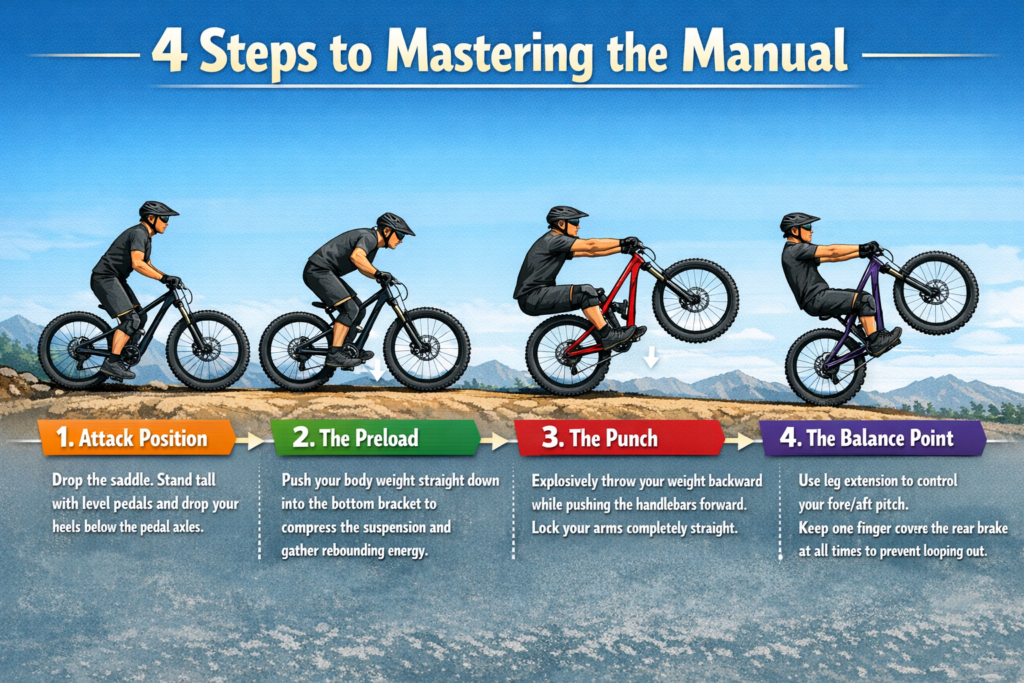
Come in at a comfortable jogging pace, somewhere between 5 and 10 mph. Get into your attack position: standing tall on level pedals, knees slightly bent and tracking outward so the top tube can pass between your legs freely, elbows wide and bent, torso hinged at the hips. Drop your heels below the pedal spindles. This is critical and often overlooked — dropped heels keep your pushing force horizontal through the bottom bracket instead of letting your feet slip off the front of the pedals during the punch.
Eyes up and ahead. Looking down at the front tire or your stem pulls your head — which is heavy — forward, and that shift works directly against you.
Step 2: The Preload and Punch
The manual initiation is a two-part sequence that coaches call the “preload and punch.” It is not a vertical pull. That distinction matters more than almost anything else in this guide.
The Preload. Compress your bodyweight straight down into the bottom bracket by bending your knees quickly and deeply. This loads energy into the tires and frame that you’re about to redirect. Don’t push down on the bars to compress the fork — that wastes the energy and can wash out the front tire on loose ground.
The Punch. The instant you hit the bottom of that compression, explode your hips backward. The goal is to get your hips directly over or behind the rear axle. At the same time, push the handlebars forward and away from you with your lats — not pull up with your biceps. Pulling up drives your chest over the bars and crashes the front wheel back down. Think of it like a rowing motion: hips flying backward while the bars get shoved away from your chest. By the end of that hip drive, your arms should be completely straight and locked. Your upper body now hangs off the bars like a counterbalance, and that lever action is what keeps the front wheel in the air.
Step 3: Learn to Fail Safely First
You cannot fully commit to the hip punch until you’ve removed the fear of looping out. That fear is exactly what makes riders half-commit, and half-committing means the front wheel never gets high enough to find the balance point.
Find a grassy slope and practice intentionally pulling too far backward. As the bike tips past the point of no return, let go of the pedals and step off the back. You land on your feet, holding the bars, and the bike is fine. Do this until stepping off the back feels completely natural and automatic.
If that still feels too risky, try this drill: stand on your bike stationary, hold the rear brake, and violently yank your hips back until the bike rears up. Bail off the back. Repeat. This physically hardwires the escape route into your nervous system so you stop flinching in the middle of the punch when it actually matters.
Step 4: Holding the Balance Point
Once the front wheel is up, the balance point is a tiny kinetic window. Here’s how to work it:
Legs control fore-aft. Your arms stay locked straight the whole time. The adjustment tool is your legs. Front wheel dropping? Push your legs straighter, drive the bike forward underneath you, and let your hips fall back further behind the axle. Tipping too far back toward a loop-out? Bend your knees slightly and bring your hips forward. Small movements, constant feedback.
Hips correct side-to-side. Unlike the seated wheelie, the standing position lets you swing your hips laterally. Tip left, swing your hips right. Stick a knee out. Carve your body to the side. This is what lets you hold a manual in a straight line instead of corkscrewing off the bike after two seconds.
Cover the rear brake at all times. One finger resting on the lever. It’s your emergency override. A light tap changes the rotation of the rear wheel enough to shift momentum forward and drop the front end instantly. It’s not a failure to use it — it’s the right tool for the job.
Manual Machine vs Flat Ground – Which Should You Use?
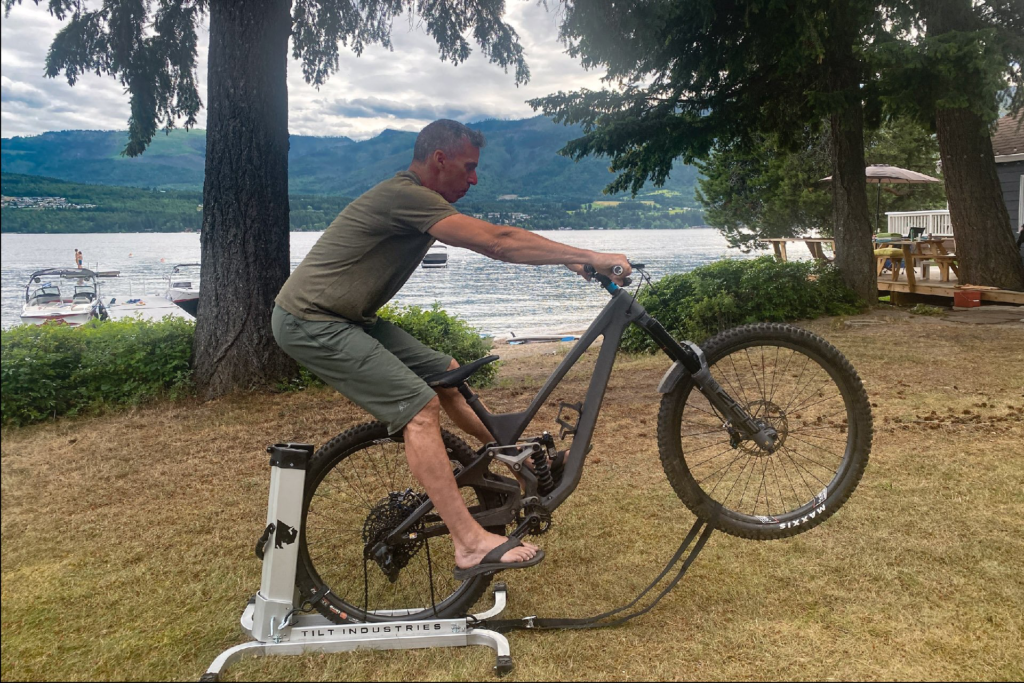
If you’ve been on any mountain bike forum in the last five years, you’ve seen the manual machine debate. These are wooden or metal trainers that lock your rear wheel in a fixed cradle so you can practice the balance point without the bike rolling or looping out. They work. And they have real limitations. Here’s an honest look at both.
Where the Manual Machine Wins
It kills the fear of looping out. This is the single biggest value of the machine. Because the rear wheel is fixed and you can add a front tether to limit vertical travel, the consequence of going too far back is zero. For absolute beginners who can’t commit to the hip punch due to fear, this is genuinely transformative.
It builds the isometric strength to hold the position. Hanging in the straight-arm, hips-back position for extended periods is physically demanding. The machine lets you train that posture until it’s second nature — building lat, core, and glute strength — without burning all your energy managing momentum and steering.
It’s a controlled environment for rear brake practice. Tapping the brake to drop the front end is a skill, and you can rep it over and over on a machine until it’s reflex.
Where the Manual Machine Falls Short
The initiation feels nothing like the real thing. On a moving bike, the gyroscopic force of the spinning rear wheel actively helps stabilize the bike. On a static machine, you have to heave the front end up with more effort and less natural assistance. Riders who only train on a machine often find their initiation feels forced and unnatural when they try it on pavement.
You never train lateral balance. The machine’s base holds the bike perfectly vertical. You don’t have to use your knees, hips, or bars to correct sideways drift — because there is none. This is a real problem. A rider who can hold a 30-second manual on a machine will frequently struggle to hold a two-second manual on pavement because that lateral muscle memory simply doesn’t exist yet.
Buy a Manual Training Machine here.
| Manual Machine | Flat Ground / Parking Lot | |
|---|---|---|
| Loop-out risk | Zero | High — requires bail-out drill mastery |
| Lateral balance training | Non-existent | Full requirement |
| Initiation mechanics | Unnatural — no momentum | Natural — uses suspension rebound and inertia |
| Balance point isolation | Excellent — hold it as long as you want | Fleeting — requires constant coordination |
| Brake feathering feedback | Good for finger muscle memory | Perfect correlation to real-world physics |
| Psychological barrier | Low — great for beginners | High — fear limits commitment |
The machine is an excellent off-season conditioning tool and a great way to get your first taste of the balance point without trauma. But it is not a replacement for parking lot reps. You need both, and you need to get on pavement as soon as the fear is manageable. Professional instructors will tell you the same thing: use the machine to build confidence and baseline strength, then take it outside and actually learn the skill.
Putting It All Together
The wheelie and the manual aren’t just cool to look at — they fundamentally change how you interact with the trail. The wheelie gives you low-speed control, torque awareness, and brake modulation skills that carry over into every technical situation you’ll face on the climb. The manual transforms your ability to carry speed through features that would otherwise slow you down, protect you on drops, and set the foundation for the more advanced riding you want to do.
Start with the wheelie if you’re newer to these skills. The saddle gives you a stable base to learn from, and the rear brake feathering practice you build will pay off in the manual work you do later. Once you have a consistent 20-foot wheelie dialed, start working on your manual initiation — preload drill, loop-out drill, parking lot reps. Lock out your rear shock, drop your saddle, and commit to the hip punch.
Neither of these skills comes quickly. But the riders who take the time to build them properly end up with a completely different relationship with the trail. Instead of reacting to what the terrain does to them, they’re actively deciding what the terrain does for them.
Are you working on manuals or wheelies right now, and what’s the specific part of the technique that’s giving you the most trouble? Let’s talk it through in the comments.