You’re staring at a spec sheet for a new Levo or Stumpjumper 15, and you keep seeing this word: GENIE. Maybe your last bike had a normal air shock and a couple of volume spacers, and that was that. Now you’re wondering if GENIE is worth paying more for, or if it’s just clever marketing wrapped around the same old air spring. Fair question.
Let’s break down what’s actually happening inside this shock, and why it changes the way you think about tuning.
What GENIE Actually Is
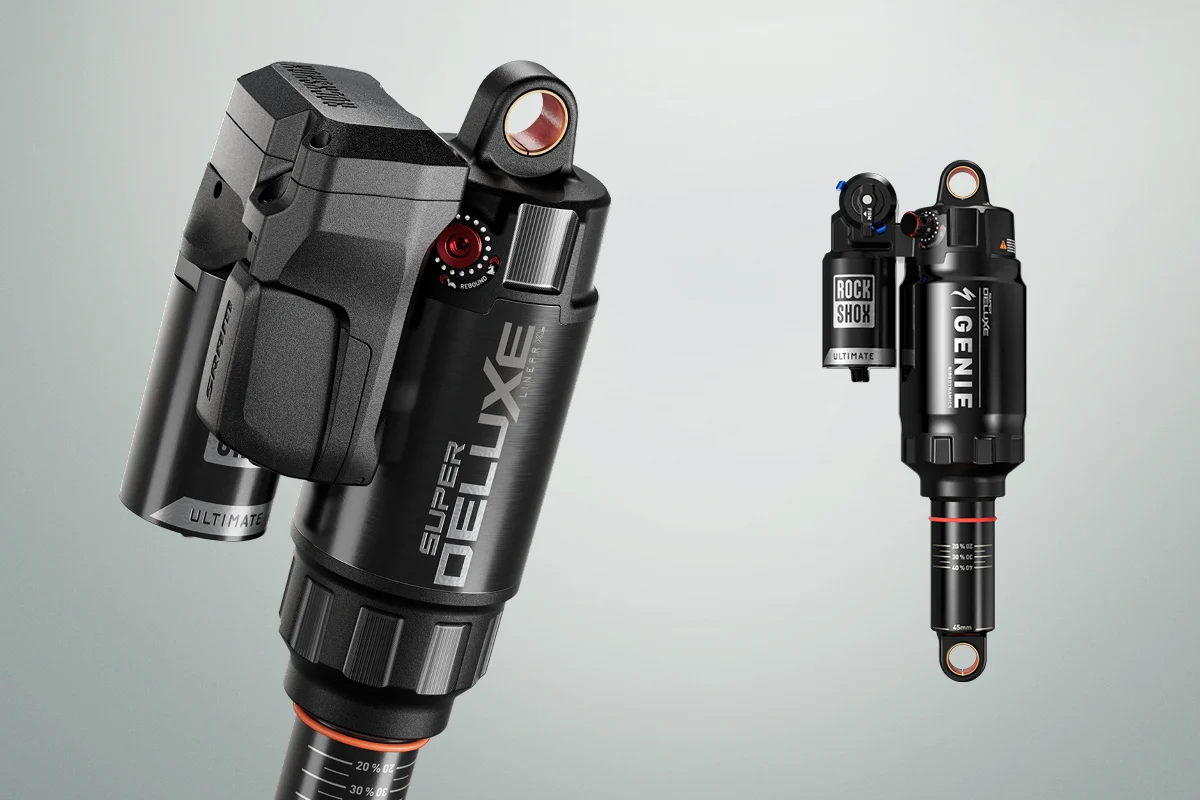
The RockShox Super Deluxe GENIE is a two-chamber air spring built for select Specialized bikes, including the Levo 4, Levo R, and certain Stumpjumper 15 trims [1]. It started life as a Fox and Specialized collaboration, and now it’s expanded into RockShox hardware too, which tells you Specialized wants this tech spread across more of its lineup rather than locked to one shock brand [1][2].
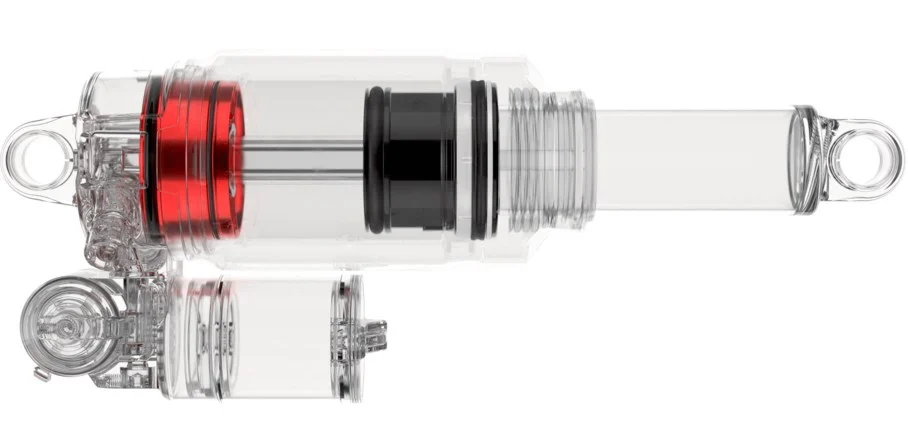
Here’s the basic idea. Instead of one air chamber doing all the work from top to bottom of the stroke, GENIE splits the job into two chambers. For roughly the first 70% of travel, both chambers work together, giving you a big combined air volume and a soft, linear feel [3]. Then, in the final 30% or so, the outer chamber closes off. That shrinks the effective air volume and spikes the progression right when you need support the most [4][5].
RockShox ties this into what it calls its LinearXL philosophy. The stated goal, according to reporting from Bike Magazin, is a spring that feels linear and sensitive through most of its travel, then ramps up hard against bottom-out, all while giving you a ride feel closer to having more travel than you actually do [3].
Why Splitting the Stroke Changes the Ride
Think about what a normal air shock does with volume spacers. You add tokens, and the whole curve gets more progressive from wherever those tokens start reducing volume. It’s a blunt tool. You’re trading a bit of small-bump sensitivity everywhere in the stroke to get more bottom-out resistance late in the stroke, because you can’t separate the two.
GENIE tries to solve that by physically separating the chambers. BikeRumor’s tech desk put it plainly: the last 30% is where the outer chamber shuts off, which increases support and ramps up progression specifically to prevent harsh bottom-outs on big hits, while the middle-to-end of the stroke gets more travel at the same bump force and better end-stroke support [1]. That’s a different design goal than just cramming more spacers into a can.
Does it actually feel different on the trail? One long-term Stumpjumper 15 Evo review backs up the marketing claim, describing the shock as linear when it makes sense, then progressive when called on, with a smooth and predictable transition between the two [Adventure Sports Network]. That’s the kind of real-world confirmation that matters more than a spec sheet.
 From the Bike198 shopIs My Bike Ok?$26Shop
 The Numbers Specialized Is Putting Behind It
Specialized has published some bold internal figures. The company claims 57% better traction for the Stumpjumper 15 with GENIE compared to a standard air damper, and 16.3% better impact management than traditional air shocks. Those numbers come from Specialized’s own testing, not an independent lab, and that distinction matters.
Specialized also shared a more concrete comparison: both the Stumpjumper 15 Alloy, with 145mm of rear travel, and the Specialized Enduro, with 170mm, absorb a 1080 N impact using 101mm of stroke. That’s a specific, checkable claim rather than a vague percentage, and it’s the kind of number worth watching for when independent testers get their hands on these bikes.
Here’s the honest take: brand-published percentages without independent dyno validation are marketing copy until someone outside the company verifies them. That’s not a knock on Specialized specifically, it’s just how the industry works. Every suspension brand rounds its own numbers in its own favor.
The traction and impact figures might hold up under scrutiny. They might not. Nobody’s published a truly independent dyno comparison yet, and that’s exactly the kind of gap an unsponsored tester should be filling.
How Tuning Actually Works on This Shock
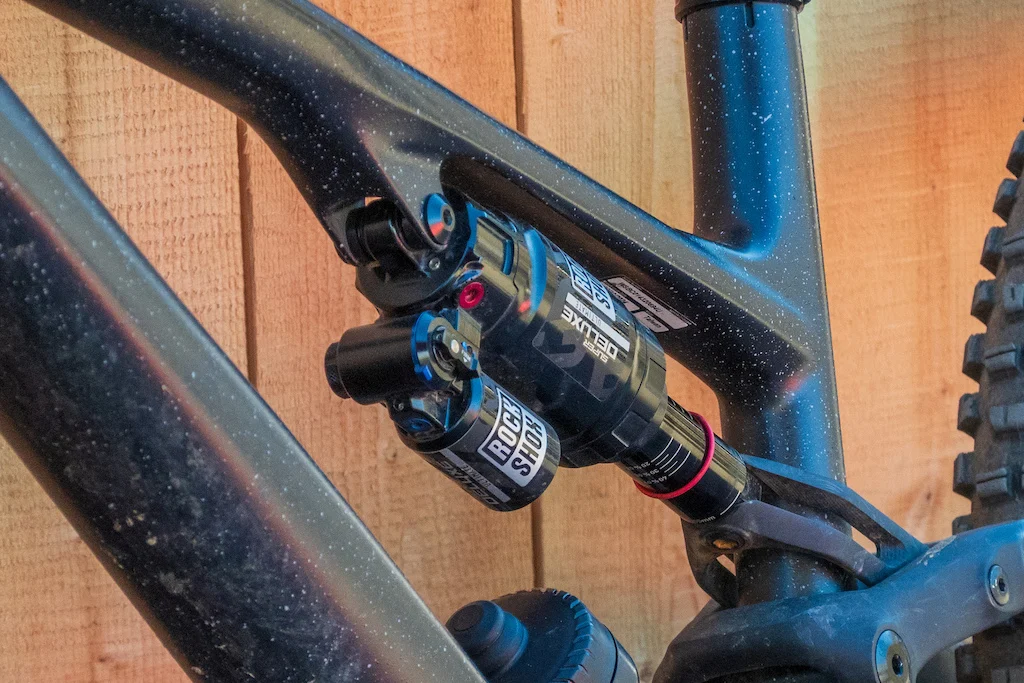
This is where GENIE gets genuinely interesting for anyone who likes to tune their own suspension. The system uses two separate token locations, and each one controls a different part of the curve.
- The outer sleeve can hold up to two tokens, and these control mid-stroke tuning [4].
- The main can, at the eyelet, takes three different-size tokens, and these control bottom-out tuning [4].
- Stock setup ships with one sleeve token and a middle-size eyelet spacer across all frame sizes [YouTube tech breakdown].
That’s a meaningfully different tuning menu than a standard Super Deluxe. On a conventional shock, you’ve got one set of spacers doing double duty for both mid-stroke feel and bottom-out resistance. Here, you can soften or firm up the middle of the stroke independently from how hard the shock ramps up at the end. If you’re the kind of rider who’s spent an afternoon swapping tokens trying to find that sweet spot between “plush” and “doesn’t blow through travel on the rock garden,” this is the setup you’ve been asking for.
Worth noting: the Super Deluxe GENIE uses a unique eyelet, sealhead, air can, damper shaft, and air-can token, but shares every other part with the standard Super Deluxe damper [1]. It’s not a totally new shock platform. It’s a modified air spring bolted onto proven damper internals, which is a smart way to keep the rest of the tune familiar while changing how the spring behaves.
Where You’ll Actually Find It (And Where You Won’t)
This is the part that’ll frustrate budget-conscious shoppers. GENIE isn’t showing up across the board. It’s confirmed on the Levo 4 in a 210x55mm size and the Levo R in 190x55mm, both sharing a C34 compression tune [4]. On the trim side, it’s currently confirmed on S-Works and Expert Levo 4, plus S-Works and Pro Levo R. Stumpjumper 15 RockShox GENIE trims have been reported but weren’t yet listed at the time of this reporting.
Meanwhile, the Levo R in S-Works and Pro spec gets a 190x45mm Super Deluxe Ultimate GENIE, a slightly different length than the Levo 4’s version, which shows Specialized is tuning shock length per platform rather than using one size for everything.
If you’re shopping the budget end of the Stumpjumper 15 range, don’t expect GENIE at all. The Alloy tiers skip it entirely, spec’d instead with an X-Fusion O2 Pro RL or a FOX DHX Factory coil, with spring rates running from 400lb to 600lb depending on frame size. That’s a real gap between trim levels, and it’s worth factoring into your budget if GENIE is the reason you’re eyeing a pricier build.
How It Stacks Up Against the Alternatives
Fox’s version of GENIE hasn’t disappeared. Some high-end Stumpjumper 15 builds still run the Fox Float X Factory GENIE in a 210x55mm size, right alongside the newer RockShox GENIE option. That’s dual-supplier adoption in action, and it gives buyers an actual choice rather than a single locked-in vendor.
One tester ran both back-to-back and found them close in feel, with the RockShox Super Deluxe taking a slight edge for a marginally lighter off-the-top feel and a bit less noise overall. That same tester noted that when GENIE is paired with a more linear fork, the whole bike feels more planted and supple. That last point matters. GENIE isn’t a standalone miracle part. It’s one half of a system, and how your fork behaves changes what you feel from the shock.
For a sense of what RockShox can do without GENIE’s dual-chamber trick, look at the Super Deluxe Ultimate RC2T with HBO. One review called it as close to coil-level sensitivity with air-spring progression as you’re going to get. That’s a useful benchmark, because it shows RockShox has more than one way to chase the same goal, and GENIE is the newest, not the only, tool in that toolbox.
Frequently Asked Questions
Is the RockShox Super Deluxe GENIE compatible with any frame?
No. It’s frame-locked to select Specialized models, including the Levo 4, Levo R, and certain Stumpjumper 15 trims, and it isn’t a bolt-on upgrade for other bikes [1].
What’s the difference between GENIE’s sleeve tokens and eyelet tokens?
Sleeve tokens, up to two of them, adjust mid-stroke feel. Eyelet tokens, up to three different sizes, adjust bottom-out resistance. They work independently, which is the core advantage over a standard single-chamber air shock [4].
Do I need GENIE, or can volume spacers get me close?
Careful spacer tuning on a standard Super Deluxe or Float X2 can get you a progressive curve, but it can’t separate mid-stroke support from bottom-out resistance the way GENIE’s two chambers do. Whether that difference matters to you depends on how sensitive you are to small-bump compliance versus big-hit support.
Why doesn’t my Stumpjumper 15 Alloy have GENIE?
Specialized gates GENIE to Expert, Pro, and S-Works trims. Alloy builds get an X-Fusion O2 Pro RL or a FOX DHX Factory coil instead, which keeps the entry price down but skips the dual-chamber tech entirely.
GENIE’s engineering claims are compelling on paper, and the early back-to-back testing backs up some of it. But the traction and impact numbers still need independent verification outside of brand-run tests. That’s exactly the kind of testing we plan to keep running here, so check back for our full trail comparison once we’ve got hours on both the RockShox and Fox versions side by side.
Sources
- Specialized Lets GENIE Out of Fox Shocks and Into …(bikerumor.com)
- Specialized GENIE shock now also available in a RockShox … (bike-magazin.de)
- Specialized GENIE Dämpfer jetzt auch als RockShox-Versiom(bike-magazin.de)
- Ultra-tuneable Specialized Genie in a RockShox can(flowmountainbike.com)
- Neuer Specialized Dämpfer RockShox Super Deluxe Genie (mtb-news.de)
Researched from 17 vetted sources · average source authority DR 71

I founded Bike198 back in 2008 and started riding bikes seriously in 1994. A lot has changed since that time and one of the greatest releases is still getting out on the bike and shredding trail or tearing up the road.